A rift is emerging between the European Union and the
United States over whether Israel should cease its offensive against Hezbollah
guerrillas.
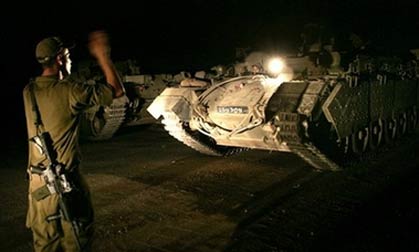
Israeli
army armored vehicles maneuver at a staging area at the border crossing
between Israel and Lebanon in Rosh Hanikra, northern Israel , Wednesday
July 19, 2006. [AP] |
The Europeans fear mounting civilian casualties will play into the
hands of militants and weaken Lebanon's government. The Bush
administration, while noting these concerns, is giving Israel a tacit green
light to take the time it needs to neutralize the Shiite militant group.
The mixed message could help Israel in its mission to destroy Hezbollah's
stronghold in southern Lebanon and stop the guerrillas' deadly rocket fire on
Israel. But Islamic hard-liners and terrorist groups could be long-term winners,
using the vivid television imagery of the death and destruction in Lebanon to
win popularity and promote their jihads.
The United States, the country that holds the most sway with Israel, has
said the Jewish state has the right to defend itself and that a
"meaningful" cease-fire is needed, presumably one which includes the disarming of Hezbollah.
White House spokesman Tony Snow said the administration opposed a return to
the situation before the outbreak of violence. "A cease-fire that would leave
intact a terrorist infrastructure is unacceptable," he said.
By contrast, the EU has called for a cease-fire now and said Israel's
"disproportionate" use of force is not only threatening Lebanon's democratic
government but providing the fuel that extremist groups such as Hezbollah need
to win public support.
After meeting with Israeli Prime Minister Ehud Olmert and Israeli Foreign
Minister Tzipi Livni on Wednesday, Javier Solana, the EU's foreign policy chief,
condemned the July 12 Hezbollah raid that led to Israel's offensive and urged
the guerrillas to immediately release the two soldiers they captured.
But he also called for a cease-fire and said diplomatic efforts to end the
crisis should continue.
Asked if Israel's attacks in Lebanon were disproportionate, Solana said that
if people think the offensive is causing "more suffering on the people than is
necessary in order to obtain an objective," it could make it harder win their
"hearts and minds" in the "battle against terrorists."
However, Livni said Israel's offensive is not just a reaction to Hezbollah's
raid, but a response to the broad threat of Hezbollah to Israel's security. From
that perspective, she said, Israel's air strikes on Lebanon are proportionate.
Israel is betting that its campaign will deliver a decisive blow not only to
Hezbollah, but to radical Islamic forces throughout the region. So far, though,
the widespread Israeli air strikes appear to have only increased the credibility
and popularity of Hezbollah leader Sheik Hassan Nasrallah in the Middle East.
Secretary of State Condoleezza Rice has discussed the crisis by
telephone with Olmert and Solana. But Rice, who had been expected to visit the region
this weekend, has refrained from setting a date, leading some to speculate that the
US wanted to give Israel more time to pursue its offensive.
At the United Nations, Deputy Secretary-General Mark Malloch Brown said that
the world body is bringing key Mideast players together Thursday for a series of
meetings to make major decisions on the next steps to try to end the escalating
hostilities.
He said that Secretary-General Kofi Annan and the three-member team sent to
the Mideast to try to defuse the crisis were returning to New York, and Rice and
Solana were flying in.
British Prime Minister Tony Blair, Bush's top overseas ally, joined the
American president on Wednesday in insisting that Hezbollah free the soldiers
and stop firing rockets at Israel before asking Israel to stop its offensive.
But other European nations backed Solana.
French President Jacques Chirac called the Mideast fighting a "dramatic
situation that deeply worries us." He urged Hezbollah to release the Israeli
soldiers and to stop hitting Israel with missiles. But he also asked the
Israelis to stop deadly bombings in Lebanon.
In Moscow, Russian Defense Minister Sergei Ivanov expressed concern that "the
war in the Middle East is escalating" and tacitly criticized Israel's use of
force, saying, "It is particularly painful to witness the destruction of the
civilian infrastructure of Lebanon."
