The United States was set to begin a major evacuation of its citizens from
Lebanon on Wednesday as thousands of foreigners fled Israeli air strikes any way
they could.
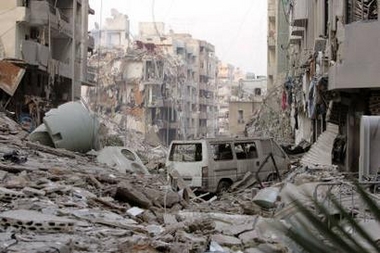
A vehicle is seen
among damaged buildings in southern Beirut July 18, 2006. Israeli
warplanes struck Lebanon on Wednesday with thousands awaiting evacuation
as the death toll mounted in a conflict that has entered its second week
with no early end in sight.[Reuters] |
Nine military ships, including a helicopter carrier and a dock landing ship,
and thousands of Marines and sailors were involved in the U.S. operation, U.S.
officials said.
More than 2,400 people would be evacuated by air and sea on Wednesday, the
first big group up to 8,000 the Pentagon expects to bring out of Lebanon.
Britain said two aircraft carriers were among six ships in the region ready
to start rescuing its citizens. The destroyer HMS Gloucester collected 180
poeple from Beirut port on Tuesday.
About 5,000 Britons would be evacuated by the end of the week, Prime Minister
Tony Blair told parliament.
Other nations mustered boats and planes to reach citizens stranded by the
bombing of Beirut airport, roads and bridges.
Countries from as far away as Chile were making arrangements to reach their
citizens. A Brazilian air force plane collected about 100 Brazilians who had
reached Turkey from Beirut. Canada said it would start evacuating its citizens
by sea on Wednesday.
The United Nations said on Tuesday it was pulling non-essential staff and
family members from Lebanon, but relief workers would stay and more would go in.
Two U.N. staff members had been wounded and another staffer and his wife were
missing, associate U.N. spokesman Farhan Haq said in New York.
Convoys of foreign nationals also travelled the hazardous route by road to
Syria from Lebanon to flee a seventh day of an Israeli bombardment which has
killed at least 235 people in Lebanon, all but 26 of them civilians.
The attacks were launched after Hizbollah fighters seized two Israeli
soldiers and killed eight in a cross-border raid on July 12. At least 13
civilians have been killed in Hizbollah rocket attacks.
In the early hours of Wednesday, the Greek navy frigate Psara arrived in
Larnaca, Cyprus, with 265 people, mostly Greeks and Cypriots, aboard. It also
carried four Americans, one Canadian, two Austrians.
"I cannot describe how I feel," said a smiling Victoria Zahar, a
Lebanese-Cypriot, who was greeting her daughter Jacky, 11, who had been visiting
her grandmother in Lebanon.
FLOTILLA ON ITS WAY
U.S. Marine helicopters airlifted 45 Americans from Lebanon to Cyprus, some
critical at the fury of the Israeli bombing.
"As an American, I'm embarrassed and ashamed," one evacuee, Seattle-based
freelance writer June Rugh, said in Cyprus. "My administration is letting it
happen (by giving) tacit permission for Israel to destroy a country."
France said it had transported 800 of its citizens by boat to Larnaca and
would return to collect some of the 6,000 other French nationals.
"We are today obviously in talks with the Israeli authorities for this boat
to be able to come and go," French Foreign Minister Philippe Douste-Blazy told
French television.
Israel is enforcing a sea blockade of Lebanon but a Foreign Ministry
spokesman said governments had approached Israel to see if it could support the
evacuation of their nationals. "We have been as helpful as we can under the
circumstances," he added.
Norway picked up 1,000 Norwegians and other Europeans by ferry, and Sweden
was collecting 1,500 people early on Wednesday. A Greek navy frigate transported
400 Europeans from Beirut to Larnaca on Tuesday.
A Spanish airforce Boeing 707 flew 113 people out of Damascus and more than
152 were being transported from Amman, the Foreign Ministry said.
Russia sent Emergencies Ministry aircraft to pick up its evacuees and Poland
and Bulgaria hired buses to ferry their nationals and Czechs and Slovaks to
Damascus.
In the German city of Duesseldorf, relatives shed tears of relief as evacuees
arrived from Damascus in a joint operation between airline LTU and the German
Foreign Ministry.
"Without the help of the German embassy we would have never got out in one
piece," said German-Lebanese woman Iman Kouteich, who was visiting her parents
near the Israeli border.
