A car bomb hit a group of labourers after they boarded a minibus in a market
in a Shi'ite city in Iraq on Tuesday, killing 59 people and sparking clashes
between protesters and police, witnesses and officials said.
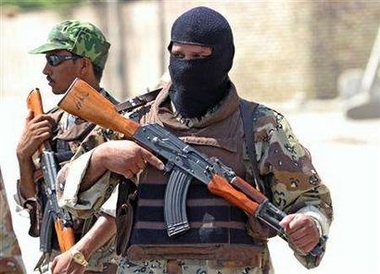
Two members of the
Iraqi security forces stand guard during Friday prayers in the town of
Kufa, September 3, 2004. A car bomb hit a group of labourers in a crowded
market in a Shi'ite city in southern Iraq on Tuesday, killing 39 people
and sparking brief clashes between protesters and police, witnesses and
hospital sources said. [Reuters] |
The blast, some 50-100 metres from a Shi'ite shrine in the southern city of
Kufa, tore through the minibus after it had pulled out of the crowded market.
Hospital and security sources said 132 people were wounded in the blast,
which dealt a fresh blow to Shi'ite Prime Minister Nuri al-Maliki's efforts to
promote national reconciliation.
Riyadh al-Shibni, a doctor in a Najaf health centre, said hospitals in Najaf
and Kuf had received 59 bodies.
Police in the scene were pelted with rocks by angry crowds. Many appeared to
be followers of radical Shi'ite cleric Moqtada al-Sadr, who has many supporters
in the town. Kufa is near the holy city of Najaf, 160 km (100 miles) south of
Baghdad.
The protesters chanted to the police: "You are traitors!" "You are not doing
your job!" "American agents!".
Police then fired into the air to disperse the onlookers and confused scenes
ensued, a Reuters reporter at the scene said.
"It is very chaotic now. The police are shooting in the air and the crowds
are running," he said. "Ambulances are racing around town."
The blast, one of the bloodiest since a government of national unity took
office in April, came a day after gunmen killed more than 50 people in
Mahmudiya, near Baghdad.
Najaf Governor Assad Abu-Kalal blamed the Kufa attack on the "criminal
Baathists and terrorists of Mahmudiya." Witnesses said the minibus had Baghdad
licence plates. The blast destroyed six cars and two restaurants in the area.
Violence between majority Shi'ites and Sunnis, dominant under Saddam Hussein
but now the backbone of an insurgency against the U.S.-sponsored political
process, has pushed Iraq to the brink of civil war.
Maliki, a Shi'ite, has urged Iraqis to rally behind his reconciliation plan
as the last hope to avert all-out war.
But Shi'ite religious and political leaders have warned that mass attacks
against their community by suspected Sunni insurgents meant their calls for
restraint and to avoid retaliation were being ignored.
Earlier this month, a suicide car bomber blasted two coach- loads of Iranian
pilgrims in Kufa, killing 10 and wounding 40.
Gatherings of labourers in crowded markets have become a favourite target of
Sunni al Qaeda insurgents, who Iraqi and U.S. officials say are intent on
sparking a civil war between Shi'ites and Sunnis.
President Jalal Talabani, an ethnic Kurd, called on clerics from both Sunni
and Shi'ite Muslim sects to condemn violence, which he said aimed to destabilise
the country and "to create a climate of mistrust among the
citizens".
