|
Blair, Annan call for forces to stop Israel raids
(AP)
Updated: 2006-07-17 14:57
ST. PETERSBURG, Russia - British Prime Minister Tony Blair and U.N.
Secretary-General Kofi Annan called Monday for the deployment of international
forces to stop the bombardment of Israel from southern Lebanon.
"The
only way we're going to get a cessation of hostilities is if we have the
deployment of an international force into that area that can stop the
bombardment coming over into Israel and therefore gives Israel a reason to stop
its attacks on Hezbollah," Blair said after meeting with Annan. "The only way
then that this is going to work ... is if we actually give people a reason for
ceasing hostilities."
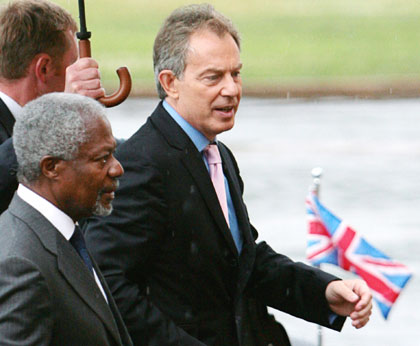
U.N. Secretary-General
Kofi Annan (L) arrives with British Prime Minister Tony Blair for a
meeting between G8 leaders and outreach leaders at the G8 summit in St.
Petersburg, Russia, July 17, 2006. They called Monday for the deployment
of international forces to stop the bombardment of Israel from southern
Lebanon. [Reuters] |
Mark Regev, a spokesman
for Israel's Foreign Ministry, said his country "would welcome a more energetic
and decisive international effort to bring about immediate and full
implementation of Security Council resolutions 1559 and 1680, which call for the
disarmament of Hezbollah."
Annan appealed to Israel to abide by
international law and spare civilian lives and infrastructure.
"We
should not inflict any more suffering on both parties and they should respect
international humanitarian law," Annan said.
He also said the United
Nations was considering evacuation plans for U.N. dependents from Lebanon, while
Blair said Britain was looking at the possibility of creating an air bridge for
its citizens.
Their comments came a day after world leaders forged a
unified response at their G-8 summit to the crisis in the Middle East, blaming
Hezbollah and Hamas for the escalating violence and recognizing Israel's right
to defend itself - although they called on the Jewish state to show restraint.
The statement was a compromise between a U.S. position strongly
supporting Israel's right to defend itself against terrorist attacks and the
views of other G-8 countries that Israel was engaging in excessive force.
"The most important thing is that it gives us - under the auspices of
the U.N. - a plan of action," Blair said.
"I am most pleased the leaders
came together with a statement to say that we condemn violence, and to honor
innocent life," U.S. President George W. Bush said Monday before heading into a
meeting with Indian Prime Minister Manmohan Singh.
"For the first time,
we've really begun to address with clarity the root causes of the recent
conflict in the Middle East, and that is terrorist acts, mainly Hezbollah that -
housed and encouraged by Syria, financed by Iran - are making these moves to
stop the progress of peace," Bush said.
Asked why the document did not
name Syria as a sponsor of terrorism, Russian President Vladimir Putin said late
Sunday that it was "our principled position."
"If we don't have enough
grounds to blame somebody, we cannot on such make our conclusions and put them
in documents on such a serious state level just based on assertions, even if we
find them logical."
|
| |
|
| |
|
|
|
| Most Commented/Read Stories in 48 Hours |
|
|
|
|
