President Bush said Thursday that Israel has the right to defend itself, as
it launched fresh attacks on Lebanon after the capture of Israeli soldiers.
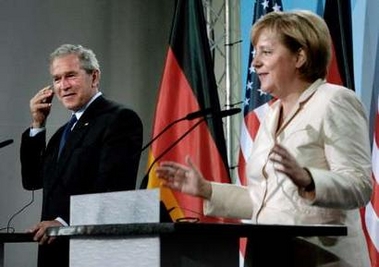
U.S. President George
W. Bush and German Chancellor Angela Merkel (R) participate in a joint
press conference in Stralsund, northeastern Germany July 13, 2006.
[Reuters] |
Bush, visiting German Chancellor Angela Merkel en route later in the week to
the G-8 summit in Russia, laid the blame for the escalation of violence along
the border on Hezbollah, whose guerrillas mounted a cross-border raid earlier in
the week and captured the two soldiers. He also said that Syria "needs to be
held to account" for supporting and harboring Hezbollah.
"The soldiers need to be returned," the president said. "It's really sad
where people are willing to take innocent life in order to stop that progress
(for peace). As a matter of fact, it's pathetic."
Bush's comments came during a joint news conference with Merkel, as Israel
intensified attacks in Lebanon.
In response to Wednesday's kidnappings, Israel bombed Beirut's airport and
the southern part of the country in its heaviest air campaign against its
neighbor in 24 years. Israel also imposed an air and naval blockade on Lebanon
to cut off supply routes to militants.
The violence comes at a delicate time in the Middle East ¡ª and for the United
States and its European allies, which are trying to preserve a coalition to
confront Iran over suspected nuclear ambitions.
Merkel appealed for restraint from both sides in the Mideast. But she
suggested they do not share equal blame, repeatedly noting that the violence
began with the kidnapping.
"I think that one needs to be careful to make a distinction between the root
causes and the consequences of something," she said.
Bush was pressed on whether Israel's military assaults, which have killed
nearly three dozen civilians, could trigger a wider war. He tempered his strong
defense of Israel by saying his "biggest concern" was that the attacks could
weaken the Lebanese government led by Prime Minister Fuad Saniora and make it
harder for the fledgling democracy movement there to continue to grow.
"Whatever Israel does, though, it should not weaken the Saniora government in
Lebanon," he said. "We're concerned about the fragile democracy in Lebanon."
"Having said that, people need to protect themselves," he added, referring to
Israel.
On Iran, both Bush and Merkel declined to take a hard line against Tehran,
which has defied appeals from the United States, Germany and other nations to
provide an answer by Wednesday on whether it would accept a package of
incentives to halt uranium enrichment. The United States and other permanent
members of the U.N. Security Council, along with Germany and the European Union,
have agreed to raise Iran's behavior at the Security Council for possible
punishment.
"I truly think they are trying to wait us out," Bush said. "And I think they
are going to be sorely mistaken. I think they are going to be disappointed, that
this coalition is a lot stronger than they think."
Said Merkel: "Should Iran not in any way reply to this offer and accept this
offer, we unfortunately have to embark on a new course."
She added, "The door has not been closed."
Downplaying tensions between U.S. and Russia ¡ª where Bush is headed on Friday
¡ª the president laughed off a snide comment directed at Vice President Dick
Cheney by Russian President Vladimir Putin.
In the former Soviet republic of Lithuania in May, Cheney had accused the
Kremlin under Putin of backsliding from democracy and bullying Russia's
neighbors on energy.
"I think the statements of your vice president of this sort are the same as
an unsuccessful hunting shot," Putin said in an interview with NBC broadcast on
Wednesday. The remark referred to Cheney's shotgun blast on a hunting trip that
accidentally wounded a companion.
"It was pretty clever," said Bush, who meets with Putin ahead of a summit of
world leaders. "It was quite humorous, not to diss my friend the vice
president."
Both Merkel and Bush said they would like to see democratic reforms in Russia
and would press that point in private. But they agreed they are reluctant to
criticize Putin harshly in public.
"Nobody really likes to be lectured a lot," Bush said.
With Merkel, Bush was celebrating a new era of relatively tension-free
U.S.-German relations. The controversy between the two countries over American
detentions at the Guantanamo Bay prison in Cuba didn't even come up in their
joint availability ¡ª either in remarks by the leaders or questions from
reporters.
And the subject of the war in Iraq, which so divided Bush and Merkel's
predecessor, former Chancellor Gerhard Schroeder, was barely mentioned.
While Bush was in Germany, however, the White House did announce that Iraqi
Prime Minister Nouri al-Maliki would be visiting Washington later this month to
meet with the president. The two first met on June 13, when Bush made a surprise
trip to Baghdad.
"I bring a message from the American people: we're honored to call the German
people friends and allies," Bush told a crowd of several hundred gathered for
his arrival in this northern port city's old market square.
Merkel welcomed Bush to her home district in the formerly communist Eastern
Bloc region with a gift of a small barrel of local herring. The president
laughed, both surprised and pleased.
A military band played marches in the cobblestoned city center ¡ª towered by
St. Nicholas Church and a town hall dating to medieval times ¡ª where most of the
president's events for the day took place.
In the evening, Bush's visit to Merkel's old neighborhood was wrapping up
with a wild boar barbecue in the small town of Trinwillershagen.
Though anti-Bush protesters gathered, thousands of police were keeping most
far from the areas Bush was to tour.
But before the president's arrival from an overnight in a resort town on the
Baltic Sea, a representative from the environmental group Greenpeace struggled
to display a yellow "No War, No Nukes, No Bush" banner from the church's clock
tower.
Reflecting the widespread dislike of the Iraq war in Germany, eight rainbow
peace banners also hung from the trade union building on the square, directly
across from Bush's podium.
Security was tight. Fighter jets patrolled the skies and police checked the
city's 2,200 manhole covers, welded shut to ensure nothing disrupted Bush's
visit. Residents were prohibited from opening windows and shops were ordered
closed.
