Asia-Pacific
Rice warns North Korea on missile test
(AP)
Updated: 2006-06-20 08:54
 |
Large Medium Small |
US Secretary of State Condoleezza Rice warned North Korea on Monday it will face consequences if it test-fires a missile thought to be powerful enough to reach the West Coast of the United States.
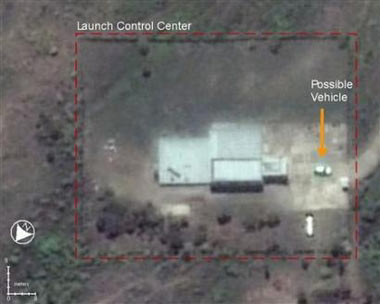 A commercial satellite photo of North Korea's Nodong missile launch site taken on by a Digital Globe satellite and annotated and released by analysts at GlobalSecurity.org on May 24, 2006. The United States and Japan warned North Korea on Monday against a missile launch that experts say could reach as far as Alaska and threatened harsh action if the test flight goes ahead. [Reuters] |
"It would be a very serious matter and, indeed, a provocative act should North Korea decide to launch that missile," Rice said amid indications that the North Koreans could launch an intercontinental ballistic missile at any moment.
The senior US diplomat said the United States would talk to other nations about action should the North go ahead, and "I can assure everyone that it would be taken with utmost seriousness."
US President Bush briefly discussed the missile test with Russian President Vladimir Putin during an 18-minute phone call the Russian official placed to the American president on Monday. The leaders plan to remain in touch on the missile issue, said Kate Starr, a spokeswoman for the US National Security Council.
The United States, Japan, Australia, South Korea and other countries have urged North Korea to abandon any missile firing. US officials said Monday the missile was apparently fully assembled and fueled, giving the North a launch window of about a month.
Unlike other preparatory steps the United States has tracked, the fueling process is very difficult to reverse, and most likely means the test will go ahead, one senior administration official said.
The precise timing is unclear, the official said.
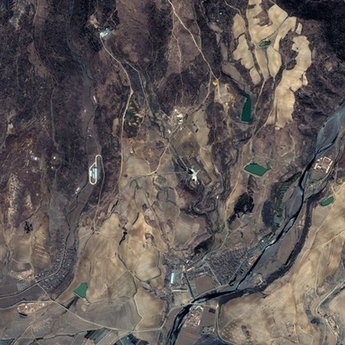 In this satellite image released by GeoEye, the Taepodong missile launch complex in North Korea, called Musudan-ri, is shown in 2001. North Korea said Sunday, June 18, 2006, it is seeking to increase its military deterrent to cope with US moves in a restatement of its typical anti-Washington propaganda, amid increasing signs that the country is preparing for a missile test. [AP] |
At UN headquarters in New York, US Ambassador John Bolton said he was holding preliminary consultations with Security Council members on possible action if North Korea fires the missile, thought to be a three-stage Taepodong-2 with a non-nuclear payload.
"But we don't really know what the North Korean intentions are at this point, so I think we need to wait for the event," Bolton said.
The US ambassador to Japan, Thomas Schieffer, said economic sanctions were an option.
"I think sanctions would have to be considered, but I wouldn't want to describe what actions we might take," Schieffer said through a US Embassy official.
US officials have said the 116-foot-long missile has a firing range of 9,300 miles and could reach as far as the US West Coast. Most analysts, however, say North Korea is still a long way from perfecting technology that would make the missile accurate and capable of carrying a nuclear payload.
The North's missile program has been a major security concern in the region, adding to worries about a pursuit of nuclear bombs. North Korea test-fired an earlier missile version over northern Japan in 1998.
Japan says a new launch would threaten Japanese security and violate an agreement North Korea signed in 2002 and reaffirmed in 2004. Rice said it would also end a self-imposed moratorium on test firings that North Korea has observed since 1999 and a disarmament bargain it struck with the United States and other powers last year.
Rice said a launch now "would once again show North Korea is determined to deepen its isolation, determined not to take a path that is a path of compromise and a path of peace, but rather instead to once again saber-rattle."
The reports of a potential launch came during a prolonged hiatus in nuclear disarmament talks among North and South Korea, China, Japan, the United States and Russia. The earlier disarmament deal gives the North economic rewards for giving up weapons.