Asia-Pacific
Quake toll tops 5,000, aid pours in
(Reuters)
Updated: 2006-05-29 11:33
 |
Large Medium Small |
Tens of thousands of homeless survivors of an earthquake that killed more than 5,000 people in Indonesia spent the night camped out in the rain as aid from across the world arrived on Monday.
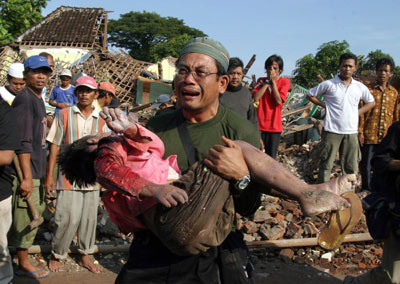 An Indonesian volunteer carries the body of a six-year-old boy who was dug out from a ruined house in the town of Klaten in central Java May 28, 2006. [Reuters] |
Many survivors who were injured or whose homes were destroyed by the quake spent a rainy Sunday night in the open on the grounds of hospitals and mosques or in makeshift shelters beside the rubble of their houses.
Flows of foreign and domestic aid were increasing on Monday as the official death toll from the 6.3 magnitude quake reached 5,115. The tremor early on Saturday was centred just off the Indian Ocean coast near Yogyakarta, the former Javanese royal capital.
Outside Yogyakarta's main hospital, the number of injured being treated was much reduced from Sunday although the corridors were still packed with patients.
"I am still traumatised, especially when it rained last night," said Sartoyo, who had come to the hospital from a nearby village. "Everyone was in panic ... and rushing inside the hospital.
"I heard help is on the way," he added. "We badly need tents, please note that. Do not forsake us."
Government figures put the number of injured at 2,155, but the United Nations children's fund (UNICEF) said 20,000 had been injured and more than 100,000 made homeless.
Government and private aid agencies agree shelter in the form of tents is a top aid priority, along with clean water supplies.
Under the Debris
An estimated 35,000 homes and buildings in and around Yogyakarta were reduced to rubble by the quake, and by Monday morning chances were slim that many people were still alive under the debris.
|
|
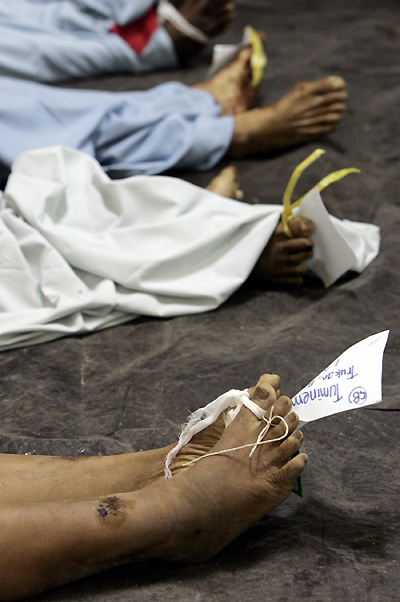
The international community has rallied to help, offering medical relief teams, disaster experts and emergency supplies.
The government declared a three-month emergency and President Susilo Bambang Yudhoyono moved his office to Yogyakarta.
After a cabinet meeting late on Sunday, Vice President Jusuf Kalla put relief and rebuilding costs at around 1 trillion rupiah ($107 million) and said the government aimed to complete "reconstruction and rehabilitation" within a year.
Kalla said the quake had destroyed power facilities worth 200 billion rupiah and deprived tens of thousands of electricity.
In Yogyakarta on Monday a group from Peditan village were loading dozens of friends and relatives onto a truck to head home.
Walji Mardiutomo, whose mother in her 70s was injured in the quake, said: "Doctors said she can go home, her forehead has been stitched. Fourteen people out of 600 from our villages died."
"Our village is flat to the ground. We will used makeshift tents to stay there," she told Reuters.
Rubling Merapi
Medical supplies and body bags arrived at the airport of Yogyakarta, about 25 km (16 miles) from the coast. The airport was closed to commercial traffic.
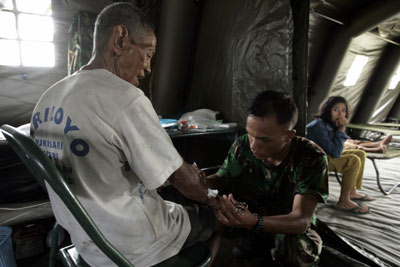 An Indonesian soldiers treats a villager at a tent hospital in Bantul, near Yogyakarta, May 28, 2006. Rescue workers dug desperately for survivors on Sunday and hospitals struggled to cope with the thousands of injured, a day after an earthquake killed more than 5,000 people on Indonesia's Java island. [Reuters] |
A vulcanologist said the quake had heightened activity at nearby Mount Merapi, a volcano that experts believe may be about to erupt. Merapi has been rumbling for weeks and sporadically emitting hot lava and highly toxic hot gas.
Throughout the disaster-struck region, authorities struggled to deliver aid.
"The problem now is that we are still short of tents, many people are still living on the streets or open areas," Suseno, a field officer of the Yogyakarta disaster task force, said.
Social Minister Bachtiar Chamsyah urged understanding. "I have already told you that the area destroyed by the quake is very large ... We need time.
Saturday's quake was one of the worst disasters in modern Indonesia's history. The worst, the December 26, 2004 quake and its resulting tsunami, left some 170,000 people dead or missing around Aceh. Indonesia sits on the Asia-Pacific's so-called "Ring of Fire", marked by heavy volcanic and tectonic activity.
Yogyakarta is a prime tourist attraction, home to ancient and protected heritage sites such as Borobudur, the biggest Buddhist monument on Earth, which survived the quake.
But the Prambanan Hindu temple complex suffered some damage, as did nearby roads and houses, a Reuters witness said. Local media reported that outer sections of Yogyakarta's centuries-old royal palaces had also collapsed.