Asia-Pacific
East Timor Cabinet to meet, thousands flee capital
(AP)
Updated: 2006-05-29 09:06
 |
Large Medium Small |
East Timor's Cabinet was set to hold a crisis meeting Monday as thousands of residents fled the burning capital and rival gangs prowled the streets armed with machetes.
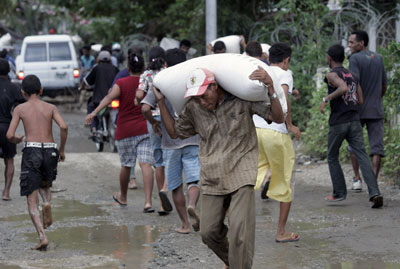 A East Timorese man carries bag of rice that he looted from the World Food Program warehouse in Dili May 28, 2006. Hundreds of Timorese looted the warehouse, taking huge bags of rice after disrupting an attempt to distribute supplies to women. They were ordered to drop the bags by patrolling Australian soldiers, but when the troops were called to another disturbance the looters carried on where they left off. [Reuters] |
The meeting came amid growing speculation that the government could be near collapse or that parliament will be dissolved. Prime Minister Mari Alkatiri has called the violence an organized plot to overthrow him.
A week of bloodshed has killed at least 27 people, probably more, raising concerns that one of the world's youngest nations is plunging into a civil war, seven years after its traumatic break for independence from Indonesia's iron-fisted rule.
The United Nations evacuated hundreds of employees over the weekend, while its special representative in Dili said more international peacekeepers may be needed to restore order in the capital.
The current violence resembles East Timor's upheaval in 1999 when its vote for independepence from Indonesia in a referendum sparked widespread mayhem by militias linked to the Indonesian military. East Timor declared itself independent in 2002.
What began in recent months as a schism within the armed forces spilled over in the past week to the general population, which is divided on geographical lines of east and west, or those perceived to have been pro-Indonesian against those who wanted independence.
Rival gangs torched homes and battled with machetes for a third day on Sunday. Fire across the city filled the sky with smoke overnight and into Monday, and the streets were strewn with smoldering debris while Black Hawk helicopters roared overhead.
Australian troops rumbled toward the sound of gunfire in armored personnel carriers, but seemed to only briefly scatter combatants.
The U.N. special representative to East Timor, Sukehiro Hasegawa, said goodbye to around 300 staff members being evacuated to Australia, while cautioning that more peacekeepers may be needed to end the lawlessness. He appealed to leaders not to fan the flames of hatred.
"They have a difference of views in how to manage the country and the (situation) is very, very fragile in their state," he told reporters on Sunday.
Japan joined Australia and the United States and other nations in pulling out non-emergency staff, as nearly 200 Chinese nationals sought shelter at the country's embassy.
More than 60 Filipinos were also evacuated Sunday on a Philippine air force plane. China said it would send a charter plane on Monday to evacuate its nationals.
About 27,000 East Timorese sought refuge at shelters, said Robert Ashe, regional representative for the U.N. High Commissioner for Refugees. But the tent camps had almost no sanitation. Children splashed in puddles polluted by human waste and many didn't have access to food and drinking water.
Aquilino Soares Torres, 34, fled to the airport with his wife, relatives and eight children. He complained that the foreign troops were failing to end the conflict.
"The don't move into the neighborhoods where the violence is taking place," he said, holding a baby in one arm. "I think the situation will get worse. I am ready to leave the country with just the shirt on my back."
The unrest was triggered by the March firing of 600 disgruntled soldiers _ more than 40 percent of the 1,400-member army _ and is the most serious crisis East Timor has faced.
After staging deadly riots last month, the sacked troops fled the seaside capital, setting up positions in the surrounding hills and threatening guerrilla war if they were not reinstated.
Four people were killed Sunday, one of them burned to death while trying to defend his home and the others shot, witnesses and hospital officials said.
A group severely beat a man they accused of hiding guns. His life was spared after foreign reporters intervened and he was rushed bleeding to the hospital by aid workers.
Australia said it will send up to 50 federal police officers to help contain marauding gangs and that around 2,000 Australian troops were either on the ground or in transit to East Timor.