Asia-Pacific
Indonesian quake kills more than 400
(AP)
Updated: 2006-05-27 14:02
 |
Large Medium Small |
The magnitude 6.2 quake struck at 5:54 a.m. 15 miles southwest of the city of Yogyakarta, causing damage and casualties there and in at least two other nearby population centers, officials said. Yogyakarta, on the island of Java, is around 18 miles from the sea and about 250 miles east of the capital, Jakarta.
In the chaos that followed the quake, rumors of an impending tsunami sent thousands of people on Java fleeing to higher ground in cars and motorbikes. But Japan's Meteorological Agency said there was no danger of a tsunami.
The quake also triggered heightened activity in nearby Mount Merapi volcano, which has been spewing out clouds of hot ash, gas and lava for several weeks, a scientist said.
Five hours after the quake struck, at least 291 bodies had been recovered, and the death toll was expected to climb, morgue officials told The Associated Press by telephone.
"Please tell the central government to send help, we need help here," said Kusmarwanto of Bantul Muhammadiyah Hospital, the closest hospital to the quake's epicenter.
"There so many casualties. Houses ... are flattened. Many people still need to be evacuated," he said, adding that his hospital alone had 39 dead bodies and the numbers were rising.
"We are overwhelmed with bodies," said Subandi, a morgue official at Bethseda hospital in Yogyakarta.
Witnesses at hospitals said hundreds of injured were arriving for emergency treatment, many with broken bones and cuts.
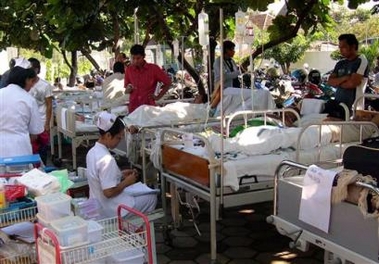 Victims are treated outside a hospital after a strong earthquake in Yogyakarta, Central Java, Indonesia, Saturday, May 27, 2006. A powerful earthquake rocked Indonesia's Central Java province early Saturday, flattening buildings and killing at least 211 people, hospitals and officials said. Scores of other people were injured.[AP] |
TV footage showed damaged hotels and government buildings, and several collapsed buildings.
The quake cracked the runway in Yogyakarta's airport, closing it to aircraft until at least Sunday while inspections take place, Transport Minister Hatta Radjasa said.
Electricity and communications were also down in parts of the city, police said.
"It felt really powerful, and the whole building shook," said Narman, a receptionist who goes by one name at a hotel in Yogyakarta. "Everyone ran from their rooms."
The quake's epicenter was close to the Mount Merapi, which has been rumbling for weeks. Activity increased as a result of the temblor, with one eruption soon after the earthquake sending debris some 2 miles down its western flank, said Subandrio, a vulcanologist monitoring the peak.
"The quake has disturbed the mountain," he said.
There were no reports of injuries as a result of the eruption.
Activity at Mount Merapi, one of the world's most active volcanoes, has picked up in recent weeks and almost all villagers living near the danger zone have been evacuated.
Indonesia, the world's largest archipelago, is prone to seismic upheaval due to its location on the so-called Pacific "Ring of Fire," an arc of volcanos and fault lines encircling the Pacific Basin.
A magnitude 9.1 earthquake on Dec. 26, 2004, under the sea off the coast of Indonesia's Sumatra Island triggered a tsunami that killed more than 131,000 people in nearby Aceh province, and more than 100,000 others in nearly a dozen other countries.