Iran renewed its threats to withdraw from the Nuclear Nonproliferation Treaty
on Sunday, with its president saying sanctions would be "meaningless" and its
parliament seeking to put a final end to unannounced inspections of its nuclear
facilities.
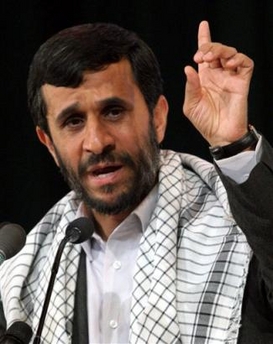
Iranian President Mahmoud Ahmadinejad delivers
his speech during a gathering of commanders of Basij, a paramilitary
volunteers group affiliated with the Revolutionary Guards, in Tehran,
Iran, Sunday, May 7, 2006. [AP] |
The comments recalled the case of North Korea, which left the treaty in 2003.
Last year Pyongyang declared it had nuclear weapons ¡ª unlike Tehran, which says
its nuclear program is only for generating electricity.
On Monday, a spokesman in Tehran said that Iranian President Mahmoud
Ahmadinejad has written to President Bush proposing "new solutions" to their
differences.
Government spokesman Gholam-Hossein Elham said the letter would be the first
in 27 years from an Iranian leader to an American president.
Meanwhile, Ahmadinejad said he would not hesitate to reconsider NPT
membership, speaking as Washington and its allies pressed for a U.N. Security
Council vote to suspend Tehran's uranium enrichment program.
"If a signature on an international treaty causes the rights of a nation be
violated, that nation will reconsider its decision and that treaty will be
invalid," he told the official news agency IRNA.
Iran's parliament made similar threats in a letter to United Nations
Secretary General Kofi Annan read on state-run radio, saying the dispute over
Iran's nuclear program must be resolved "peacefully, (or) there will be no
option for the parliament but to ask the government to withdraw its signature"
from a protocol to the NPT allowing for intrusive inspections of its nuclear
facilities.
The Iranian letter also said parliament might order Ahmadinejad's government
to review procedures for pulling out of the nuclear treaty, which signatories
may do if they decide extraordinary events have jeopardized their "supreme
interests."
The U.S. is backing attempts by Britain and France to win Security Council
approval for a U.N. resolution that would threaten possible further measures if
Iran does not suspend uranium enrichment ¡ª a process that can produce fuel for
nuclear reactors to generate electricity or, if sufficiently processed, to make
atomic weapons.
President Bush, in an interview with ARD German television, said "an armed
Iran will be a threat to peace. It will be a threat to peace in the Middle East,
it will create a sense of blackmail, it will encourage other nations to feel
like they need to have a nuclear weapon. And so it's essential that we succeed
diplomatically."