Iran's top nuclear negotiator said Tuesday that Tehran
would halt all cooperation with the U.N. nuclear watchdog if the Security
Council imposes sanctions against it, and warned it might go further and hide
its nuclear program if the West takes any other "harsh measures."
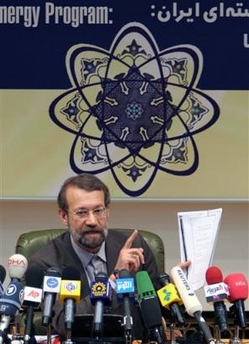
Iran's top nuclear negotiator Ali Larijani,
who is also Iran's Sercretary of Supreme National Security Council, shows
evidence of Iran's agreement with France on Iran's nuclear activities
before the 1979 Islamic Revolution, at a conference in Tehran, Iran,
Tuesday, April 25, 2006. Larijani said Tuesday that Iran will withdraw
from all cooperation with the U.N. nuclear watchdog agency if the U.N.
Security Council imposes sanctions against it.
[AP] |
The statements by Ali Larijani were Iran's strongest statement of defiance
yet before a Friday deadline the Security Council has given the country to stop
all uranium enrichment. They came a day after Iran's president boldly predicted
the Security Council would not impose sanctions on Tehran and warned he was
thinking about dropping out of the Nuclear Nonproliferation Treaty.
"Military action against Iran will not end our program," Larijani said
Tuesday, speaking at a conference on the energy program. "If you take harsh
measures, we will hide this program. If you use the language of force, you
should not expect us to act transparently."
He also said flatly that Iran would not abide by the Friday deadline to
suspend uranium enrichment.
"If you take the first step wrong, the wrong trend will continue. We welcome
any logical proposal to resolve the issue. They just need to say why should we
suspend," Larijani said.
Iran's former President, Hashemi Rafsanjani, speaking at the same conference,
claimed that Iran openly launched its nuclear program ¡ª which it insists is for
peaceful energy purposes only ¡ª "but the behavior of Western countries forced it
to carry out its nuclear program independently, based on local expertise and
knowledge without relying on Western countries."
The International Atomic Energy Agency's chief spokesman, Marc Vidricaire,
said Tuesday it would not comment on Iran's threat to scuttle all cooperation if
sanctions are imposed. He said the IAEA planned no public statements ahead of
agency head Mohamed ElBaradei's report to the Security Council and the agency's
35-nation board of governors, expected by the end of this week.
The United States, Britain and France maintain that Iran actually wants
enriched uranium for atomic bombs, which would violate its commitments under the
treaty. Iran denies the charge, but Washington is pressing fellow members of the
Security Council to impose economic sanctions.
Meanwhile, an Israeli defense official said Israel was launching a satellite
to spy on Iran's program, as Iran's leader persisted with his calls for the
Jewish state's destruction.
Israel planned to launch from Siberia later Tuesday its Eros B satellite,
designed to spot images on the ground as small as 27 inches, the defense
official said. That level of resolution would allow Israel to gather information
on Iran's nuclear program and its long-range missiles, which are capable of
striking Israel, he said, speaking on condition of anonymity because of the
sensitive subject matter.
On Monday, President Mahmoud Ahmadinejad called Israel a "fake regime" that
"cannot logically continue to live." Last year, he called the Nazi Holocaust a
"myth" and declared that Israel should be "wiped off the map."
Ahmadinejad's government insists the nonproliferation treaty gives Iran the
right to enrich uranium for fueling civilian nuclear power plants, and he has
given no ground in the international faceoff. The fiery hardline president said
Monday he was reconsidering Iran's adherence to the treaty, which is aimed at
stopping the spread of atomic weapons while allowing peaceful uses of nuclear
energy.
"What has more than 30 years of membership in the agency given us?" he asked
at a news conference, only the second since he took office last year at which
foreign journalists have been allowed to ask questions.
As a member of the IAEA, Iran is obliged to honor the agency's basic nuclear
safeguards agreement. However, that agreement is limited to select declared
atomic facilities and programs.
It is not the first time Iran has threatened to curb cooperation: Several
months ago, Tehran announced it would not honor the U.N. nuclear watchdog's
so-called "additional protocol," which gave the IAEA increased and more thorough
inspection powers.
Suspicions about Iran's intentions have grown since it was discovered in 2002
that Tehran had for two decades secretly operated large-scale nuclear activities
that could be used in weapons making.
The IAEA says it has since found no direct evidence of an arms program, but
it also says the Iranians have not been fully forthcoming in answering questions
about their nuclear activities. After repeated attempts to resolve the issue
through negotiations, the IAEA reported Iran to the Security Council for
noncompliance.
Iran deepened international concerns by announcing April 11 that it had for
the first time enriched uranium with 164 centrifuges ¡ª a step toward large-scale
production of nuclear fuel.
The United States and others are urging the Security Council to take a
tougher stance by imposing a mandatory order for Iran to halt enrichment, a move
that would raise the threat of sanctions.
Russian and China, which are among the five permanent members that can veto
council actions, have opposed that approach, saying diplomacy has not run its
course. Ahmadinejad appears to be banking on their support to dissuade
Washington from pressing a sanctions vote.