The
United States may turn to the U.N. nuclear watchdog agency to exert more
pressure on Iran, diplomats said Wednesday.
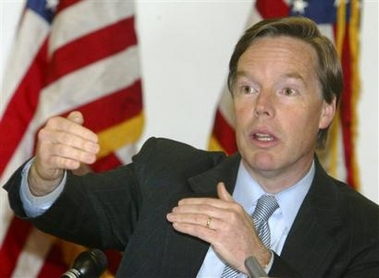
U.S. Under Secretary
of State Nicholas Burns gestures as he speaks during a news conference in
Moscow, Wednesday, April 19, 2006. Burns said Wednesday that a majority of
the countries that are permanent members of the U.N. Security Council and
Group of Eight members support possible sanctions against Iran in the
dispute over the country's nuclear program.
[AP] |
The diplomats told The Associated Press that the U.S. delegation to the
International Atomic Energy Agency has contacted other nations over the past few
days to gauge support for a special IAEA board meeting on Iran's nuclear
program.
The envoys, who were familiar with the discussions but spoke on condition of
anonymity because they were not authorized to reveal the American initiative,
emphasized that no decisions had been made.
Adam Ereli, a State Department spokesman, said the United States was waiting
for a report later this month by IAEA chief Mohamed ElBaradei about Iran's
nuclear program.
"We will study that report carefully and decide on next steps at that time,"
Ereli said.
Still, diplomats' statements that Washington might consider such action were
significant.
U.S. officials have for weeks been publicly in favor of shifting
international attention over Iran's nuclear program from the Vienna-based IAEA ¡ª
which has no enforcement authority ¡ª to the Security Council, which has the
power to impose sanctions backed by the threat of military force.
Years of U.S. lobbying paid off in February, when the IAEA's 35-nation board
agreed to refer Iran's nuclear file to the Security Council. But since then, the
council's five veto-holding members have been divided, with Russia and China
opposing efforts by the U.S., France and Britain to move from requesting Iranian
compliance to demanding it.
The split appeared to persist Wednesday.
Russian Foreign Minister Sergey Lavrov urged Iran to halt all uranium
enrichment after a meeting in Moscow among senior officials of the five
permanent council members plus Germany, but he acknowledged the talks produced
no decision on how to proceed if Tehran failed to comply.
U.S. Undersecretary of State Nicholas Burns told AP in Moscow that the
possibility of sanctions had been discussed but indicated more talks were
needed.
"What is new is a greater sense of urgency given what the Iranians did last
week," Burns said later to reporters, alluding to Iran's announcement that it
had succeeded in enriching uranium.
Burns, echoing a statement Tuesday by President Bush, did not reject the
possibility of a military response.
"Obviously, the United States always keeps all options on the table ... but
we're focused on diplomacy," he said.
In Paris, French President Jacques Chirac and Egyptian President Hosni
Mubarak said they opposed military intervention in Iran.
"We have to explore all the possibilities offered by a diplomatic option in
order to avoid a destabilization of the Middle East, and probably of the rest of
the world," Chirac said at a joint news conference.
Military strikes on Iran "would have very grave effects" on the region,
Mubarak said.
British Prime Minister Tony Blair, Bush's closest ally in the invasion of
Iraq, told his Parliament that "nobody is talking about military invasion" of
Iran.
But he also urged the international community to send a strong, unified
message to Tehran. "I do not think it is time to send a message of weakness," he
said.
Lavrov said no decisions had been expected at Tuesday's meeting because the
nations were waiting for the IAEA's report. He said Russia wants the report to
be reviewed by the IAEA board before it goes to the Security Council.
The council has set an April 28 deadline for Iran to suspend production of
enriched uranium, a material that can be used to fuel nuclear reactors that
generate electricity or to make nuclear bombs.
Iran says its nuclear program is peaceful, but the United States and dozens
of other countries fear it wants the technology to make the core of nuclear
warheads.
The enrichment issue has gained urgency because of recent claims by
Iran that if true would bring it closer to the capability for making atomic bomb
weapons.
Iranian President Mahmoud Ahmadinejad said
a week ago that his country was testing a sophisticated centrifuge
to enrich uranium. A day earlier, Ahmadinejad had trumpeted Iran's success in enriching a
small amount of uranium using 164 less-sophisticated centrifuges.
Neither claim has been publicly confirmed by the IAEA. Iran would need at
least 1,000 of the less advanced P-1 centrifuges working for over a year to
produce enough nuclear material for a bomb. Two diplomats, speaking separately,
said the IAEA planned to send in two teams of investigators this week to follow
up on both claims ahead of ElBaradei's report.