Iran's president has thrown a new wrinkle into the nuclear debate by claiming
his country is testing a centrifuge that could be used to more speedily create
fuel for power plants or atomic weapons.
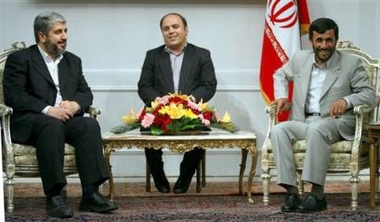
Iran's President
Mahmoud Ahmadinejad, right, meets with former Palestinian Hamas leader
Khaled Mashaal, left, during a meeting in Tehran, Iran, Sunday, April 16,
2006. [AP] |
But some analysts familiar with the country's technology said Monday that
President Mahmoud Ahmadinejad could be deliberately exaggerating Iran's
capabilities, either to boost his own political support or to persuade the U.N.
nuclear watchdog agency to back off.
The U.N. Security Council has demanded that Iran cease enrichment work, which
the United States and some of its allies suspect is meant to produce weapons.
Russia and China, two of the council's five veto-holding members, have opposed
punishing Iran.
Russia's Foreign Ministry said Monday the Kremlin insists on a diplomatic
solution to the standoff rather than any tough measures against Iran. And
Russia's U.N. ambassador said that Moscow is hopeful that Iran will suspend
uranium enrichment before an April 28 Security Council deadline, suggesting that
the Islamic republic's tough line so far was a negotiating tactic.
A Western diplomat said officials of the U.S., Russia, China, Britain, France
and Germany would discuss the matter in Moscow on Tuesday.
Ahmadinejad, in a speech to students last week, claimed for the first time
that Iran is testing a P-2 centrifuge for enriching uranium. Such a device would
be a vast improvement over the P-1 centrifuges that Iran says it has used to do
small-scale enrichment.
Iran previously told the International Atomic Energy Agency it gave up all
work on P-2 centrifuges three years ago. It was not clear if Iran has been doing
work all along on the updated model, or recently restarted efforts, or even if
Ahmadinejad's comment was accurate.
But his assertion is sure to raise concerns that Iran might have a more
sophisticated atomic program than had been believed. The IAEA and some
independent groups have long questioned whether Iran might have a parallel,
secret nuclear program that is further along.
"Our centrifuges are P-1 type. P-2, which has quadruple the capacity, now is
under the process of research and test in the country," Ahmadinejad told
students in remarks that were not reported by the official Iranian news agency
but were later found on the presidential Web site.
Iran insists it is building up a nuclear program only for peaceful purposes ¡ª
to generate electricity. But the United States and many of its allies think the
Iranians want nuclear weapons.
Iran has come under pressure in recent months to halt all uranium enrichment,
but Ahmadinejad is adamant it will press forward.
"He was likely posturing for his own political advantage and playing to
national sentiment. We have to remember that the nuclear issue is very popular
in Iran," said Khalid R. al-Rodhan, an Iran nuclear expert at the Center for
Strategic and International Studies in Washington.
Anthony Cordesman, also an expert at CSIS, said there was no way to gauge
either the truth or the significance of Ahmadinejad's statement.
"Just making a claim about individual technical developments doesn't tell you
a thing about what progress has really been made, or how it would change their
operational capabilities," Cordesman said.
Officials at the IAEA, the U.N. nuclear watchdog based in Vienna, Austria,
refused to comment.
The IAEA has believed for some time that Iran obtained the plans for a P-2
centrifuge. Some experts believe the designs were in Iranian hands as long ago
as the late 1980s through a black-market network run by A.Q. Khan, the father of
Pakistan's nuclear bomb.
Iran previously told the IAEA that the only work it had done on the P-2
design was carried out between 2002 and 2003 and was very limited. It also said
the work was halted in 2003, when Iran went back to the P-1 design.
But the IAEA has repeatedly questioned that claim and accused Iran of not
coming clean on past efforts.
"We know that they have had the drawings for P-2 centrifuge and they've
publicized that," said Gary Sick, professor of international affairs at Columbia
University and a former adviser to the U.S. National Security Council.
"But up till now, they have said that they were not in fact pursuing that
path. If in fact Ahmadinejad said that, it is a significant change," Sick said.
A diplomat in Vienna who agreed to discuss the matter only if not quoted by
name because he was not authorized to speak with reporters, said if Iran has
secretly developed its P-2 program, that could mean it will be able to produce
weapons-grade enriched uranium faster and in greater quantities than previously
thought.
The latest estimate from the CIA and other U.S. intelligence agencies says
Iran could not create a bomb before the next decade. But that analysis was based
on Tehran using P-1 centrifuges.