Asia-Pacific
Efforts underway to revive N.Korea nuclear talks
(Reuters)
Updated: 2006-04-10 14:30
 |
Large Medium Small |
Diplomatic efforts to revive six-party talks on North Korea's nuclear arms program gathered steam in Tokyo on Monday, but prospects for a key meeting between U.S. and North Korean negotiators remained unclear.
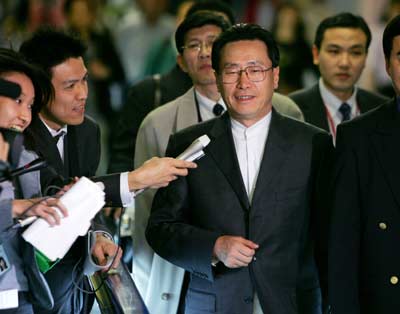 Chinese Vice Foreign Minister Wu Dawei (C) is surrounded by the media upon his arrival at New Tokyo international airport in Narita, east of Tokyo, April 9, 2006. China's chief negotiator Wu arrived in Tokyo on Sunday, where he will be joined by envoys from other countries involved in the six-way talks aimed at preventing a nuclear crisis on the Korean peninsula. [Reuters] |
China's envoy to the six-way talks, Wu Dawei, met Japanese counterpart Kenichiro Sasae on Monday morning and then met North Korea's chief delegate, Kim Kye-gwan, diplomatic sources said.
Speculation had been growing that the North Korean and U.S. envoy Christopher Hill would meet on the sidelines of a private security forum in Tokyo and manage to create the momentum for the resumption of the six-way talks, which are aimed at preventing a nuclear crisis on the Korean peninsula.
Asked about possible contact between Kim and Hill, who arrives in Tokyo later on Monday, South Korea's chief negotiator, Chun Yung-woo, told reporters: "As far as I see, there is not much of a chance for a North-U.S. meeting."
North Korea's Kim, however, said later: "It would be good if we can meet (U.S. officials)," Kyodo news agency reported.
Chun said there would be a three-way meeting among South Korea, the United States and Japan, as well as bilaterals, on the sidelines of a "track-two" private security forum bringing together officials and academics.
Susan Shirk, research director at the Institute on Global Conflict and Cooperation, University of California at San Diego, which is sponsoring the forum, told the opening session:
"As a track-two body, we are not a substitute for the official six-party talks ... although we are pleased to be able to support the six-party talks with intellectual ideas and clearing up of misunderstandings."
The six countries agreed in September that North would end all nuclear programs in return for aid and a promise for security and better diplomatic ties.
But the last session in November aimed at devising a plan to implement that deal produced no progress.
The talks involve the two Koreas, the United States, Japan, Russia and China.