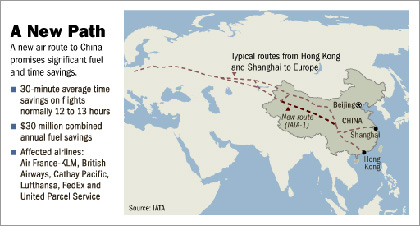
After six years of talks, China has agreed to open a new corridor through its
tightly restricted air space that could save airlines a total of $30 million in
annual fuel costs and trim an average of half an hour off flight times between
China and Europe, according to the International Air Transport Association, the
main trade group for the world's airlines.
The savings is important but not huge, given the blow that high fuel prices
have dealt airlines. Still, creation of the new route is the first of several
steps the IATA wants Chinese authorities to make to unclog the country's sparse
network of air corridors and prevent lengthening delays in flights to and from
China's biggest cities.
The need to ease
restrictions on China's air space has gained urgency, the IATA says, because of
the profusion of foreign airlines flying to the country and the torrid growth of
China's own carriers.
More Chinese are flying than ever before, as restrictions on travel are
loosened and the nation's middle class expands. To meet China's booming demand
for air travel, the government's current five-year economic plan calls for
Chinese airlines to acquire around 650 new jetliners by the end of 2010, a 75%
expansion in the size of their combined fleets. An anticipated deluge of
visitors to the 2008 Olympic Games in Beijing would add to the pressure on
China's already congested air routes.
Initially, 110 flights a week could benefit from the new route, which will
shave half an hour from a trip that normally lasts 12 to 13 hours, the IATA
said. Carriers likely to benefit include Air France-KLM, British Airways, Cathay
Pacific Airways, Lufthansa, FedEx and United Parcel Service. The IATA said the
accord would slice a collective $30 million off the annual fuel bill of the
airlines that it affects.
Although Chinese aviation authorities generally support the liberalization
the IATA has been seeking, China's armed forces, which have ultimate control of
the country's air space, have been more reluctant. They perceive foreign
airlines as a possible threat to national security and prohibit them from flying
over military bases and other sensitive installations.
Only 30% of China's air space is open to civil aviation, making it one of the
world's most restricted countries. Airlines flying over Chinese territory must
follow rigid and often meandering routes replete with doglegs and 90-degree
turns, each of which means that flights take longer and burn more fuel than if
they followed a straighter line.
The Chinese "are kind of in a league of their own" in terms of air-space
restrictions, said David Behrens, the IATA's director of safety, operations and
infrastructure in the Asia-Pacific region. For example, in Australia and many
other countries, jetliners can divert from their planned flight paths to detour
around a thunderstorm. Chinese air-traffic controllers are much less flexible,
and a severe storm can temporarily halt flights along a route over China, Mr.
Behrens said in an interview.
Although military control of air space isn't unusual elsewhere, armed forces
in most other countries have cooperated more readily with the IATA to improve
access to air space, Mr. Behrens said. India, Pakistan and Iran took just two
years to approve new air routes, while in China, a wait lasting four to six
years "is not uncommon," he said.
Still, Mr. Behrens welcomed approval of the new route across western China as
a sign of a new, more accommodating approach.
"That's the good news. I think that China as a whole is realizing that things
are changing rapidly and that's going to require changes in air space," said Mr.
Behrens, who helped lead the IATA's negotiations with the Chinese. "We are
having more dialogue with the military than we have had in the past."
An official at China's Air Traffic Management Bureau declined to comment on
the agreement or prospects for expanded access in the future.
The new route, which opens officially Thursday, will create a shortcut for
airlines flying between Europe and the Chinese cities of Shanghai, Guangzhou and
Hong Kong, and between Europe and Manila. Airlines traveling from southern China
and Manila to Europe typically fly north across China and then take a sharp,
70-degree turn to the Northwest before exiting Chinese air space. The new route,
referred to as IATA-1, is a corridor measuring 955 nautical miles (with an
optional spur of 224 nautical miles) that will partly flatten out this sharp
angle.
http://online.wsj.com/public/article/0,,SB114461934528421208-mb9ufjbxM_Nb5XJ20hIlqrXa7jQ_20060416,00.html?mod=regionallinks