Shrugging off U.S. opposition, the head of the International Atomic Energy
Agency will go to Tehran next week in hopes of securing nuclear concessions from
the Iranian leadership, diplomats and officials said Friday.
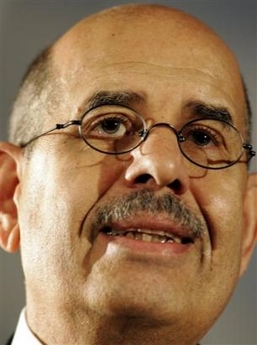
Director General of
the International Atomic Energy Agency (IAEA) Mohamed ElBaradei speaks as
he was awarded with the 'Mund-auf' ('Speak your mind') award in Karlsruhe,
southern Germany, in this March 25, 2006 file photo. Shrugging off U.S.
opposition, the head of the International Atomic Energy Agency will go to
Tehran next week in hopes of securing nuclear concessions from the Iranian
leadership, diplomats and officials said Friday April 7, 2006.
[AP] |
While the trip was meant to defuse tensions generated by fears Iran could be
seeking atomic weapons, a partial success by IAEA chief Mohamed ElBaradei could
exacerbate differences among the five permanent members of the U.N. Security
Council and derail U.S. hopes of firm action against Tehran.
Iran could commit to meet some Security Council requests while falling short
of demands to freeze uranium enrichment, a possible pathway to nuclear arms.
That could placate Russia and China, which oppose tough anti-Iran moves, but
fall short of full compliance sought by the United States, France and Britain.
The five countries wield veto power as permanent Security Council members.
The 15-nation council, which can impose sanctions, already is split along
East-West lines on how tough it should be against Iran. If ElBaradei receives
commitments that please Moscow and Beijing, that would further complicate
U.S.-led efforts to secure a firmly worded resolution demanding Iran comply.
The U.S. mission recently urged ElBaradei not to go and France and Britain
backed that request, but he decided to make the trip anyway, diplomats
accredited to the agency said, speaking on condition of anonymity because they
were not authorized to speak on the issue.
After-hour attempts to reach Vienna-based U.S. diplomats for comment were
unsuccessful.
The trip was unexpected, although diplomats close to the agency said
ElBaradei had a standing invitation from Iran to visit but was reluctant to go
without hopes of progress.
One diplomat warned against heightened expectations, saying ElBaradei would
not negotiate any settlement but expected to get some concessions. A senior IAEA
official said separately that ElBaradei expected positive results from the trip,
but was unlikely to get Tehran to recommit to a freeze of enrichment activities.
Still, it appeared ElBaradei was hoping to wrest at least partial concessions
from Iran ¡ª if not on enrichment, then on other issues of concern to the
international community, including a decision earlier this year to cut back on
the scope and frequency of IAEA inspections.
Other problems facing the agency include spotty information on Tehran's
enrichment program, leading to fears it might be hiding facilities beyond the
ones it has revealed to the IAEA.
The agency, which started investigating Iran more than three years ago after
learning it had been running a secret nuclear program for nearly two decades,
also is concerned with "dual use" experiments and materials that could be used
in nuclear weapons programs.
It has noted apparent military involvement in what Tehran says is strictly a
civilian program and earlier this year sounded the alarm over drawings showing
how to mold fissile material into the shape of warheads.
Tehran insists it is not interested in nuclear weapons and refuses to
re-impose a temporary freeze on enrichment, saying it has a right to that
activity to make nuclear fuel under the Nonproliferation Treaty.
Enrichment uses centrifuges to spin uranium gas to low-grade levels, suitable
for fuel, or highly fissile material, which can be used to make bombs.
While it plans to run thousands of centrifuges in its drive to run a
full-scale enrichment program, Tehran's known enrichment capabilities are now
restricted to a 164-centrifuge pilot plant at Natanz.
Officials familiar with the facility say it could start operating within
days. The expertise learned from the plant could be applied to large-scale
enrichment with the potential of producing material for hundreds of warheads.
The timing of the planned visit also is important. It will occur only about
two weeks before ElBaradei is to report to the Security Council on whether Iran
has heeded its call to freeze uranium enrichment and fully open its nuclear
program to an IAEA probe.
Those requests were contained in a March 29 Security Council statement that
also called on ElBaradei to report back in 30 days on whether Iran was
complying.