Center
All 17 aboard survive military plane crash
(AP)
Updated: 2006-04-04 10:26
 |
Large Medium Small |
A huge military cargo plane faltered after takeoff and belly-landed short of the Dover Air Force Base runway Monday, breaking apart and drenching some of the 17 people aboard with fuel but causing no fire or life-threatening injuries.
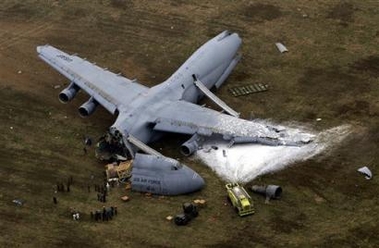 Emergency crews respond to the scene of a C-5 cargo plane that crashed carrying 17 people, just short of a runway at Dover Air Force Base, Del,, Monday, April 3, 2006. [AP] |
"It is a miracle. Absolutely a miracle," said Lt. Col. Mark Ruse, commander of the base's 436th Air Wing Civil Engineering squadron. "If you look at the condition of that plane and 17 people are still alive right now — it is absolutely amazing."
A problem occurred aboard the C-5B Galaxy, the military's largest plane, about 10 minutes after it took off for Spain. The crew turned the plane around for the crash landing, which occurred at 6:42 a.m., said Col. Chad T. Manske, 436th Airlift Wing vice commander.
Manske did not provide specifics on what went wrong, but Sen. Tom Carper, D-Del., who was briefed by military officials, said he was told the crew reported a malfunction in one of the plane's four engines.
The plane crashed in an open, grassy area about a half-mile short of the runway. The tail and nose were torn from the fuselage, along with one of the engines. Some of the 250,000 pounds of fuel spilled on the ground but did not ignite.
"It looks like it kind of slid along the ground almost like a water landing of sorts," Ruse said.
Pilots familiar with the plane say its sheer size — roughly that of a football field — likely contributed to the fact that there were no deaths.
"It's like being in a four-story building," said retired Col. Randall Larsen, a former C-5 pilot who described the plane as one of the safest in Air Force history. The C-5B is the newest version of the C-5, which was introduced in 1970.
The fact that the fuel is stored in the wings, which unlike many other planes are mounted atop the fuselage, may explain the absence of fire, said Larsen, director of the Institute for Homeland Security, a think tank in Arlington, Va.
Larsen also said that if the crew was able maintain some control of the aircraft, it was not surprising that they survived.
Some of the crew members were able to walk away and none suffered life-threatening injuries, hospital and military officials said.
Fourteen were taken to Kent General Hospital in Dover, and three were admitted. Some were covered with flammable jet fuel and had to be decontaminated in the hospital parking lot before they could be taken inside.
Three others were taken by helicopter to Christiana Hospital in Newark.
Military officials said everyone was in "fair, or better" condition.
"With that much jet fuel on the plane, not to explode, not to have consumed everyone's life, is just miraculous," Carper, a formal naval flight officer, said. "The fact that they landed the plane in a farm field ... instead of a neighborhood or a populated part of Dover is obviously a great thing."
Air Force officials said the plane was carrying supplies to support U.S. troops in the Middle East, its final destination.
The plane belonged to the 436th Airlift Wing, but was being flown by a crew from the 512th Airlift Wing, a reserve unit.
Base spokeswoman Lt. Chris Sukach said there two active-duty personnel on the plane and 11 reservists, 10 from Dover and one from Wright-Patterson Air Force Base in Ohio. Sukach said four civilians also were aboard.
The civilians included an avionics expert from Bethesda, Md.-based Lockheed Martin Corp., which manufactures the plane, said Rob Fuller, a spokesman for the company's C-5 program.
Officials said the plane made an unscheduled maintenance stop last month at Robins Air Force Base in Georgia, but they did not offer any details.
A spokeswoman at Robins, where C-5s undergo routine maintenance every five to seven years, said unscheduled maintenance visits are not unusual. Faye Banks said the plane that crashed underwent routine maintenance in September 2000 and was not due for another visit until September 2007.
Sheets said two Air Force panels will investigate the crash. A safety board will try to determine whether any issues need to be addressed immediately to prevent additional crashes. An accident investigation board will conduct an in-depth investigation that could take two to three months.
Larsen said the cause should be easy to determine because the plane is outfitted with equipment that records radio transmissions, plane intercom conversations, and data on the engines, electric and hydraulic systems, and even the position of the flight controls.