Asia-Pacific
Iran will test more weapons in Gulf wargames: report
(Iran)
Updated: 2006-04-03 20:44
 |
Large Medium Small |
Iran said it would test fire a powerful torpedo on Monday and more missiles on Tuesday as part of a week of wargames in the Gulf, a senior naval officer told state television.
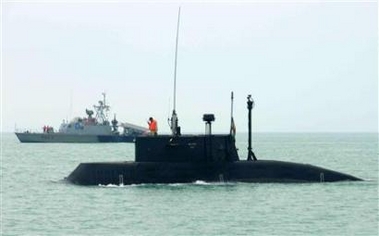 An Iranian submarine and warship take part in naval manoeuvres in the Persian Gulf and Sea of Oman April 3, 2006. [Reuters] |
Iran rarely gives enough details of its military hardware for analysts to determine whether Tehran is making genuine advances or simply producing defiant propaganda while pressure ratchets up on its nuclear program.
Although Iran can draw on huge manpower, its naval and air-force technology is largely dismissed as outmoded.
"A powerful torpedo made by experts of the Revolutionary Guards will be test fired today in the Persian Gulf. Tomorrow, we will see other missile test firings by the Revolutionary Guards in the 'Great Prophet' war game," Rear Admiral Dehqani told state television, which only gave his family name.
Iran said in February last year that it had started a mass production line of torpedoes.
The Islamic Republic has three elderly Kilo class diesel-electric Russian submarines. These are capable of firing homing torpedoes but military analysts say these vessels are unsuited to modern naval combat.
Iran has also started building midget submarines, which it says are capable of firing torpedoes.
"We are going to have very important news that will make our nation proud in the next few days," Dehqani added, without explaining. The week of wargames started on Friday.
Western nations have been watching developments in Iran's ballistic missile capabilities with concern amid a standoff over the Iranian nuclear program, which the West says is aimed at building atomic bombs.
Tehran says the program is only civilian.
Iran earlier in the wargames said it had tested a radar-evading missile and an underwater missile that can outpace enemy warships.
Iran has a commanding position over the Strait of Hormuz at the entrance to the Gulf, the world's main nexus for oil shipments.
The United States and Israel have consistently declined to rule out military action against Iran if Tehran fails to resolve the nuclear dispute through diplomatic means.