Asia-Pacific
Strong boycott in Thai polls stuns Thaksin
(Reuters)
Updated: 2006-04-03 08:42
 |
Large Medium Small |
Thai Prime Minister Thaksin Shinawatra was unable to claim the decisive mandate he sought after a strong protest vote in Sunday's snap poll pointed to a constitutional crisis.
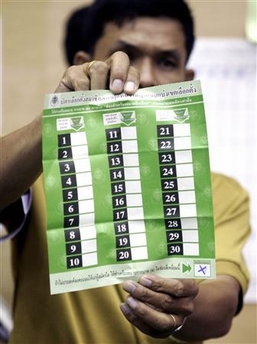 An election official holds up a 'no vote' ballot while tallying results from the Prathumwan and Ratchathewi districts of Bangkok after the end of general elections April 2, 2006. [Reuters] |
Refusing to recognize the election as legitimate, the opposition did not put up any candidates and urged voters instead to tick the "no vote" box on their ballots.
The strategy seemed to work in Bangkok where "no votes" were in a clear majority with at least half the ballots counted, Thai media said. Thaksin won 32 of Bangkok's 37 constituencies in polls last year.
Nearly 70 percent of the 399 seats at stake across the country were uncontested as a result of the boycott and many will be left empty, lacking a minimum number of votes. That will effectively prevent a new government from being formed.
Dismayed over the "no vote" trend, Thaksin was thinking about turning the government over to his deputy as a way of defusing political tensions, Thai newspapers reported on Monday quoting sources from his Thai Rak Thai (TRT) party.
For the moment, he remains head of a caretaker government.
"The poll will produce a protracted deadlock for months," political scientist Somjai Phagaphasvivat told Reuters. "The final outcome is far from certain."
Thaksin's main support is in the countryside and early returns showed him getting solid support there -- enough to hand him another big majority -- if and when parliament convenes.
Thai media said turnout was about 70 percent of the 45 million electorate, compared with 73 percent in February 2005.
Counting was slow outside Bangkok and final official results were expected only late on Monday, the Elections Commission said.
Thaksin called the election three years early to prove he had majority support against what he called "mobs" accusing him of corruption, cronyism and abuse of power. He said he would step down if his Thai Rak Thai (Thais Love Thais) party got less than 50 percent of the vote, which looked unlikely.
But the opposition boycott is likely to plunge the country into a constitutional mess because it will result in empty seats in the 500-seat parliament.
Even in an uncontested constituency, a sole candidate must win 20 percent of the eligible vote to claim the seat -- and that appeared highly unlikely in dozens of constituencies.
All seats must be filled for a new government to be formed.
In one Bangkok seat, there was no candidate on the ballot -- the unopposed TRT member having been disqualified at the last minute.
In the largely Muslim far south, where telecoms billionaire Thaksin is deeply unpopular, many unopposed TRT hopefuls were likely to fall short of the 20 percent threshold.
Bombs wounded four security men after polls closed in the region where more than 1,100 people have been killed in two years of separatist violence that many Muslims blame on Thaksin.
After a non-campaign with no competition and no suspense, Thaksin's party was still expected to get a majority of votes.
Rural Thais -- 70 percent of the 63 million population -- turned out in force to vote for a prime minister who has given them cheap healthcare and credit during his five years in office.
The crisis is taking its toll on the economy, paralyzing business decision-making and sapping the stock market, Southeast Asia's second-worst performer after Malaysia this year.
Thailand has already suspended negotiations on free trade agreements with the United States and Japan.
After saying on Saturday that both sides should "shake hands after the competition ends," Thaksin hinted his patience might not last if the street campaign leaders failed to acknowledge the results of the poll.
"It's time to bring law and order," he told reporters as he drove away from a polling station in a black Mercedes with his children, whose tax-free $1.9 billion sale of the telecoms empire he founded galvanized the opposition movement in January.
Analysts say a one-week post-election break before street protests resume on Friday could provide a cooling-off period for talks between Thaksin and his opponents.
Some voters in Bangkok disagreed. "Most people don't trust elections any more," said businessman Ponganan Limprajikul, 32. "I think there will be more protests. More people will come out to join the protests and they could become more emotional."