Center
New Mars probe sends back view from orbit
(AP)
Updated: 2006-03-25 09:49
 |
Large Medium Small |
A high-resolution camera aboard NASA's latest spacecraft to reach Mars sent back its first view of the Red Planet from orbit, the space agency said Friday.
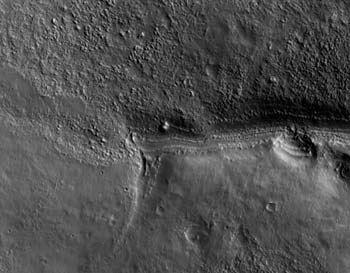 This view shows a full-resolution portion of the first image of Mars taken by the High Resolution Imaging Science Experiment camera (HiRISE) on NASA's Mars Reconnaissance Orbiter, released by NASA March 24, 2006. The spacecraft, launched August 12, 2005, began orbiting Mars on March 10, 2006. The image is of an area in Mars' mid-latitude southern highlands. This view covers an area about 4.5 by 2.1 km (1.6 by 1.3 miles.) The quality of this test image is spectacular, with no hint to the eye of any smear or blurring. A high signal-to-noise ratio reveals fine details even in the shadows. [Reuters] |
The crisp test image from the Mars Reconnaissance Orbiter was taken late Thursday at an altitude of 1,547 miles and shows a 30.9-mile-by-11.7-mile area of the planet's mid-latitude southern highlands. The mosaic of 10 side-by-side exposures shows a cratered surface with ravine- or canyon-like channels on both sides.
NASA's Jet Propulsion Laboratory said the smallest discernible objects are about 25 feet across, but that the camera will be able to capture images of objects less than three feet across once it reaches its much lower "mapping orbit."
The quality bodes well for future pictures, said Alfred McEwen of the University of Arizona, principal investigator for the High Resolution Imaging Science Experiment camera.
"The performance of the spacecraft looks superb, there's certainly no obvious smear here," he said in a telephone interview. "They have pointed us and oriented us just right to get unsmeared images."
The spacecraft reached Mars on March 10 and went into a giant elliptical orbit. Over a period of months it will dip into the upper atmosphere in a process called aerobraking to reach altitudes between about 199 miles and 158 miles and to make its orbit more circular. The science phase of the $720 million mission should begin in November.
The first image is comparable in resolution to those from the Mars Orbiter Camera aboard the Mars Global Surveyor spacecraft, which has been orbiting the Red Planet since 1997, McEwen said.
The main purpose of the initial image was to calibrate the camera. Two other cameras on the orbiter, the Context Camera and the Mars Color Imager, were also tested Thursday night during a 40-minute collection of engineering data.