The United States still believes the U.N. Security Council can reach
agreement in the coming days on a statement calling on Iran to suspend uranium
enrichment activities, a senior envoy said on Wednesday.
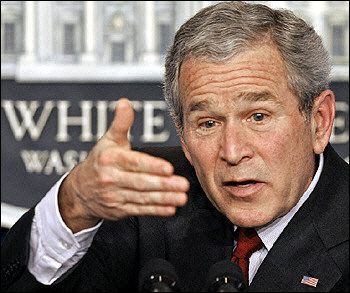
US President George W. Bush conducts a press
conference from the White House briefing room in Washington, DC. Bush said
the dispute over Iran's nuclear program must resolved diplomatically "now"
to stop Tehran from blackmailing the world with atomic weapons.
[AFP] |
"I would expect in the coming days we'll see a statement coming from the
Security Council ...," Gregory Schulte, U.S. ambassador to the International
Atomic Energy Agency (IAEA), told Reuters TV during a visit to Brussels.
He said he expected such a statement to request that Tehran implement a
resolution by the U.N. nuclear watchdog's board of governors calling on it to
suspend enrichment activities, which critics say are aimed at developing atomic
weapons.
The Security Council failed to reach accord on a text on Tuesday after days
of intensive negotiation. Russia, backed by China, wants to delete large
sections of a Franco-British draft statement aimed as a first reaction to Iran's
nuclear research.
Schulte said Washington saw no fixed deadline for Tehran to respond to
demands that it halt enrichment but warned that efforts to resolve the dispute
were "at a critical juncture".
"They (Iran) have already told the IAEA that they intend by the end of the
year to install 3,000 centrifuges. So diplomacy takes time but it needs to move
forward and it needs to move forward to keep pace with the Iranian activities,"
he said.
Centrifuges purify uranium UF6 gas into fuel suitable for nuclear power
plants or, if enriched to high levels, for bombs.
Schulte, who was due to meet European Union officials later, said it was
vital that Washington and Europe stuck to the same strategy of warning Tehran it
faced the threat of international sanctions if it did not change course.
Asked at a news conference whether U.N. Security Council approval for
sanctions would founder on Chinese and Russian vetoes, he replied: "Russia and
China clearly share the concerns of the rest of us about Iran's programme."
Schulte reaffirmed earlier U.S. statements that while no option -- including
military action -- was ruled out, Washington backed a diplomatic solution,
pointing to the offers for talks made by European and Russian officials to
Tehran.
Any contacts between the United States and Iran to discuss the situation in
Iraq would not be used as a conduit for talks on Tehran's nuclear programme or
other issues, he stressed.
"It is not for the United States to open up new channels of negotiation," he
said.