Iran's Supreme leader Ayatollah Ali Khamenei said Tuesday that he approves of
proposed talks between US and Iranian officials on Iraq, but warned that the
United States must not try to "bully" Iran.
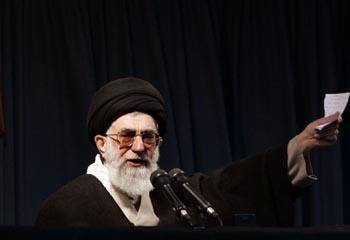
Iran's Supreme Leader
Ayatollah Ali Khamenei speaks in Mashhad 924 km (574 miles) east of
Tehran, March 21, 2006. [AP] |
It was the first confirmation that Khamenei, who holds final say on all state
matters in Iran, supports the talks. His comments appeared aimed at calming
criticism by hard-liners over a major shift in policy by the regime, which long
shunned high-level contacts with a country Tehran brands "the Great Satan."
President Bush said Tuesday he favors the talks and that American officials
would show Iran "what's right or wrong in their activities inside of Iraq."
Khamenei said that "if the Iranian officials can make the US understand
some issues about Iraq, there is no problem with the negotiations."
"But if the talks mean opening a venue for bullying and imposition by the
deceitful party (the Americans), then it will be forbidden," he said in a
nationally televised speech in the holy Shiite city of Mashhad in northeastern
Iran.
Both the United States and Iran have said the talks will focus solely on
stabilizing Iraq and not deal with the heated issue of Iran's nuclear program.
No time or place has yet been set for talks.
Khamenei appeared to be weighing in to end hard-line criticism, while
insisting Iran would not bow to the United States in any talks. He said some
US officials had depicted the talks as if the United States were "summoning
Iranian officials."
"I say here that the US government has no right to summon Iranian
officials," Khamenei said.
Khamenei is considered the leader of hard-liners in Iran who largely
prevented reformists from opening greater contacts with the United States.
Still, under his rule, Iran has held lower-level talks with American officials,
particularly in multilateral gatherings for efforts to stabilize Afghanistan and
counter narcotics, for instance.
Iranian Foreign Minister Manouchehr Mottaki said Friday that the talks could
help Iraq form a government, while Ali Larijani, the secretary of the Supreme
National Security Council, said Iran hopes the meetings will help lead to US
troop withdrawal.
Iran has considerable influence with Shiite political parties who dominate
Iraq's parliament, and Secretary of State Condoleezza Rice has said US-Iranian
talks on Iraq could be "useful."
In Tuesday's speech, Khamenei also dismissed the threat of UN Security
Council action over Iran's nuclear program.
"They threatened us with the Security Council as if the council is the end of
the world," Khamenei said, adding that Iran will pursue its nuclear program and
will achieve it with all its "heart and soul."
Khamenei made the comments as the UN Security Council postponed a meeting
Tuesday on Iran's suspect nuclear program, searching for new ways to break a
deadlock with Russia and China over the best way to pressure Tehran, diplomats
said.
The United States accuses Iran of seeking to develop nuclear weapons; Iran
says its program aims only to generate electricity and has insisted it has a
right to carry out uranium enrichment, a key process that can develop either
fuel for a reactor or material for a nuclear warhead.
The decision to postpone the meeting came after senior diplomats from the
five veto-wielding members of the council and Germany made little headway on
bridging their differences during a 4 1/2-hour meeting Monday evening. Diplomats
said Russia was the main holdout, with China following behind.
That deadlock has forced Britain, France and Germany ¡ª the European troika
leading negotiations on Iran ¡ª to reopen the text of a statement that would be
the first Security Council response. Diplomats will focus on bilateral talks to
try to find an agreement, they said Tuesday.
"We'll just keep working on it," US Ambassador John Bolton said.
The United States and its European allies want a statement reiterating
demands by the UN nuclear watchdog, the International Atomic Energy Agency,
that Iran suspend uranium enrichment, the process that can be used to generate
nuclear power or make nuclear weapons.
Diplomats said the Russians and Chinese have not budged
from their opposition to tough language including a demand for a report in 14
days on Iran's compliance with the IAEA demands. Moscow and Beijing have said
that is not enough time, with China suggesting 30 to 45 days.