Iran reiterated that its nuclear program is not up for negotiation, despite
possible calls by the UN Security Council for it to accede to demands by the UN
nuclear watchdog and immediately halt all nuclear enrichment activities.
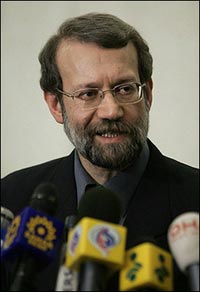
Head of Iran's Supreme National Security
Council, Ali Larijani, seen here during a press conference in Tehran on 16
March. Iran reiterated that its nuclear program is not up for negotiation,
despite possible calls by the UN Security Council for it to accede to
demands by the UN nuclear watchdog and immediately halt all nuclear
enrichment activities. [AFP] |
"We do not hinge our nuclear activities on a negotiation that is not
dignified and will not attain our rights," Iran's chief nuclear negotiator, Ali
Larijani, was quoted as saying by state news agency IRNA.
"We are ready for negotiation, but a negotiation which does not intend to
dissuade Iran from having nuclear technology for peaceful purposes. If so we
will not accept it," he told volunteer militia, Basij university instructors.
"The West does not want us to have nuclear technology, but Iran will continue
its path with resistance, since it is our legitimate right," he said. "We are a
member of the Non-Proliferation Treaty, and we are seeking our rights with in
it, like all other signatory nations," said Larijani, secretary of Iran's
Supreme National Security Council.
In an implicit reply to remarks made by the US on the possible preemptive
military action against Iran, Larijani said: "Military threats show how weak
they are, since they cannot fulfill them. We are ready for them and we have the
plans for it."
US President George W. Bush restated his belief in preemptive military action
in a 49-page National Security Strategy that also warned: "We may face no
greater challenge from a single country than from Iran."
White House national security adviser Stephen Hadley refused to rule out
military force against the Iran but denied that that the blueprint, the first
since 2002, was a message for Tehran.
However, the United States on Thursday denied that it was firing a warning
shot at Iran by reaffirming its strike-first policy of preemption nearly three
years after the start of the war in Iraq.
"We have said it many times, our nuclear program is a peaceful one. The right
of the Iranian people of having it is not negotiable," Foreign Minister
Manouchehr Mottaki told Tehran worshippers in speech before the sermon.
The International Atomic Energy Agency's "reporting Iran's nuclear case to
the United Nations Security Council is a politicized move," Mottaki added.
Meanwhile, the head of Iran's body Guardian Council vetting body, Ayatollah
Ali Janati said: "They have taken us to the Security Council; they can do what
ever they want to do."
However, he added "we will resist and we are ready to pay the price."
Leading the Friday prayer sermon, Janati said "we have to stand firm since
the glory of Islam and Muslims depends on things like this."
The full council is set to meet Friday to consider a Franco-British statement
calling on Iran to accede to all demands made by the IAEA and immediately halt
all nuclear enrichment activities.
The text urges Iran to resume implementation of the nuclear Non-Proliferation
Treaty's Additional Protocol, which allows for wider inspections of a country's
nuclear facilities.
It also requests IAEA head Mohamed ElBaradei to report on Iranian compliance
within 14 days.
Larijani said: "Those who are in a hurry to solve Iran's issue in two weeks
are digging for confrontation with Iran, and in order to counter it we need to
unite."