Iran's top nuclear negotiator headed for new talks in Vienna Thursday with
angry words for the United States and no reported progress on a compromise to
end the international standoff over the Islamic republic's suspect atomic
program.
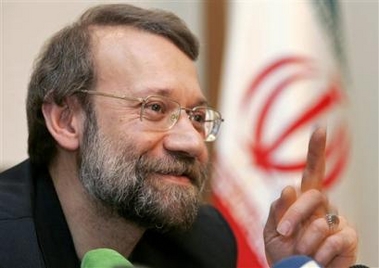
Iran's top nuclear
negotiator Ali Larijani gestures at a news conference at the Iranian
Embassy in Moscow, Thursday, March 2, 2006. Larijani said Thursday that no
date has been set for the next round of talks with Russia on its offer to
host the Iranian uranium enrichment program, but added that Tehran will
have talks with the European Union before next week's meeting of the
United Nations nuclear watchdog. [AP] |
Ali
Larijani was to sit down Friday with key European foreign ministers and senior
nuclear negotiators, just three days before the United Nations nuclear watchdog
meets in the Austrian capital to recommend action to the U.N. Security Council,
which has the power to issue sanctions against Iran.
On Thursday Larijani accused the United States of scuttling Moscow talks that
ended with no movement reported toward a deal that would move part of Iran's
nuclear program to Russia, to assuage concern that Iran would divert enriched
uranium to make a bomb. Iran, which restarted some enrichment activities last
month after a voluntarily freeze, says it wants only peaceful nuclear energy.
"America is lying, trying to destroy the Russian proposal," Larijani said at
a news conference in Moscow. "The Americans' insistence on handing over the
Iranian nuclear dossier to the U.N. Security Council means the destruction of
the Russian proposal."
In response to the unusually heated rhetorical assault, State Department
spokesman Adam Ereli said: "If Iran has a problem with the state of affairs and
the situation it finds itself in, Iran has only itself to blame."
A diplomat familiar with the negotiations, who spoke to The Associated Press
on condition of anonymity because he was not authorized to discuss them, said
Iran had requested the Vienna meeting.
The diplomat said Britain, France and Germany would not compromise Friday on
their demand that Iran give up enriching uranium inside its borders.
For the meeting to be productive, a letter from the three nations' foreign
ministers said, Iran must give a clear commitment to return immediately to "full
and sustained suspension of all enrichment-related ... activity." The letter,
dated Feb. 27 and shared in part with The Associated Press, also demanded that
Iran recommit to allowing the U.N.'s International Atomic Energy Agency
pervasive, short-notice inspections of its nuclear activities, after withdrawing
such rights last month.
Enrichment is a process that can produce fuel for a nuclear reactor or
fissile material for a bomb.
A European official suggested France, Britain and Germany had agreed to a
final meeting with Iran's negotiator before the IAEA board meeting next week to
dispel any notion that Europe was not interested in a negotiated solution.
"We are in a listening mode ¡ª nothing more," the official said by telephone
from outside Vienna. He also spoke on condition of anonymity because he was not
authorized to discuss the negotiations.
Meanwhile, a key Iranian opposition figure said that Iran has ramped up its
production of missiles capable of carrying atomic warheads.
Providing what he said were secret details of those missile programs, Alireza
Jafarzadeh told the AP Thursday that Iran had "significantly increased the
production line" of its Shahab 3 missiles last year, and was now turning out 90
a year ¡ª more than four times its previous production rate.
Jafarzadeh has worked for the political wing of the Mujahedin Khalq, an
Iranian opposition group that Washington and the European Union list as a
terrorist organization.
Jafarzadeh, who heads the Washington-based Strategic Policy Consulting think
tank, helped reveal what was then Iran's clandestine nuclear program three years
ago. In January he divulged details of Iran's enrichment plans, which were
confirmed a few days ago by the IAEA.
However, other accusations he has made against Iran remain unproven. There
was no independent confirmation of the information Jafarzadeh offered Thursday,
which he said he received from unspecified sources inside Iran.
The most advanced Shahab has a range of nearly 1,200 miles, Jafarzadeh said.
That is enough to target arch-foe Israel.
Working together with North Korean experts at the Hemmat Missile Industries
complex in Tehran, Iranian engineers also were "70 percent" finished on
prototype Ghadar 101 and Ghadar 110 missiles, which have a range of up to 1,800
miles, he said, putting central Europe within reach. These missiles also were
"ready for launch" within 30 minutes, compared to several hours for the Shahab,
he said.
U.S. intelligence chief John Negroponte told lawmakers Wednesday in
Washington that the risk of Iran acquiring nuclear arms and merging them with
ballistic missile systems was "a reason for immediate concern."
Meetings that started in 2004 between the Iranians and Europeans failed to
find common ground on enrichment, leading to a chain of events that resulted in
the IAEA board reporting Tehran to the security council Feb. 4.
In exchange for backing that move, Russia and China ¡ª which have strong
political and economic ties to Iran ¡ª insisted the council wait for the results
of Monday's IAEA board meeting before taking any action.
Larijani said his team had put forward a "package proposal" in Moscow, and
denied that the discussions had ended in failure. "We need to give diplomats
time to look at it."
A Russian nuclear agency official, who spoke on condition of anonymity
because he was not authorized to speak to media, confirmed the Moscow talks had
snagged over Iran's refusal to freeze enrichment.