The UN nuclear watchdog's treatment of Iran is politically motivated,
President Mahmoud Ahmadinejad said on Friday, the day set for his country's
last-ditch nuclear talks with European nations.
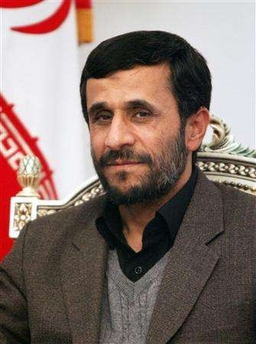
Iranian President
Mahmoud Ahmadinejad is seen in Tehran, Iran February 5, 2006. Ahmadinejad
said on Friday the UN nuclear watchdog's treatment of his country was
politically motivated. [AP] |
Ahmadinejad, who is visiting Malaysia, accused international bodies of bias,
in remarks seen by at least one regional diplomat as aimed at his audience at
home.
"Regrettably most international organizations have turned into political
organizations and the influence of great powers prevents them from taking fair
and legally sound decisions," Ahmadinejad said in a speech.
"The IAEA's ( International Atomic Energy Agency's) treatment of the Islamic
Republic of Iran is politically motivated."
Top EU powers will meet Iran's chief nuclear negotiator for a last stab at
dialogue before an IAEA meeting that could bring Security Council steps against
Tehran over fears it secretly seeks atom bombs.
Ahmadinejad, who is known for adopting a hawkish rhetorical stance, seemed to
be using the strong public statements to try and smooth his negotiator's way in
the talks.
Iran wanted the talks but would not accept anything that was forced upon it,
the Iranian president said.
"We never seek a fight, we believe in dialogue," said Ahmadinejad,
accompanied on his trip by a large Iranian press contingent. "If some parties
want to ... impose something on my nation, experience tells me and them that the
Iranian nation will make them sorry.
"We are ready to talk and cooperate with everyone, with one exception, which
is the Zionist regime," he said.
The West, led by the United States, suspects Iran is covertly seeking to
build an atomic weapon. Iran denies this, saying it is pursuing nuclear programs
purely for civilian use.
Thursday's word of the talks in Vienna was a surprise, given Iran's defiance
of international calls to rein in nuclear work.
But Iran seems keen to brake momentum toward Security Council action, and the
European Union appears keen to show it will listen, if not bend, to Tehran
before weighing sanctions.
But no breakthrough seems on the cards, given that Tehran is speeding up
uranium enrichment work geared to fuelling nuclear power plants or, potentially,
weapons while going slow in talks on a Russian compromise proposal to defuse the
crisis.