Iran
Reports: China, Iran near huge oil deal
(AP)
Updated: 2006-02-17 21:51
 |
Large Medium Small |
Chinese and Iranian officials in Beijing said they could not confirm the report.
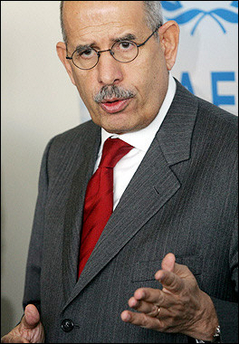 International Atomic Energy Agency (IAEA) chief Mohamed ElBaradei speaks to the press in Vienna. The UN nuclear watchdog was set to haul Iran before the UN Security Council over suspected atomic weapons work and Iran was threatening sharp retaliation. [AFP] |
Staff at Iran's embassy in Beijing said they were aware of the report but had not heard Mou's remarks, which Caijing said were made at a recent embassy event.
A written statement from the Iranian Embassy noted that the two countries have been working together in various energy fields, "following the rule of mutual benefits and respect in all bilateral cooperation."
Calls to Sinopec's headquarters were not answered late Friday.
The Caijing report said Chinese and Iranian officials met in December for talks on the project. It cited Mou as saying the two governments and companies involved were moving ahead with the deal despite the controversy over Iran's nuclear program.
According to the Caijing report, Sinopec would hold a 51 percent stake in the Yadavaran project, with India's Oil and Natural Gas Corp., or ONGC, taking 29 percent. The remainder would go to Iranian companies and possibly to Royal Dutch Shell PLC, which has also expressed interest, it said.
The report said there was some disagreement over intended capacity, with Iran asking China to agree to daily output of 300,000 barrels of oil, while Sinopec preferred to set a target of 180,000 to avoid excess production.
Sinopec, Asia's largest refiner, has shares traded in New York, London, Hong Kong and Shanghai.
China, seeking oil and gas to fuel its booming economy amid stagnant production at home, has been snapping up energy resources in places as far flung as Venezuela, Kazakhstan, Nigeria and Australia. Its investments in Iran and Sudan have prompted complaints it is undermining diplomatic efforts to bring recalcitrant regimes in line.
Beijing has strongly urged that a diplomatic solution be found to the impasse over Iran's nuclear program.
Western nations fear that Iran plans to develop nuclear weapons, but Iran insists its intentions are purely for generating electricity. Growing international concern about its aims contributed to Tehran being reported to the U.N. Security Council by the 35-nation board of the International Atomic Energy Agency, the U.N.'s nuclear watchdog.
On Thursday, France's foreign minister, Philippe Douste-Blazy, accused Iran of secretly making nuclear weapons.
The Security Council is due to consider Iran's nuclear activities next month. The council has the power to impose economic and political sanctions on Iran, but members China and Russia could exercise their veto power against such measures.
