Iran
Iran revives atom enrichment work
(Reuters)
Updated: 2006-02-15 08:57
 |
Large Medium Small |
Iran on Tuesday resumed feeding uranium gas into centrifuges for nuclear-fuel enrichment after a break of 2-1/2 years, stoking a diplomatic showdown with the West which suspects Tehran secretly seeks to build atomic bombs.
Iran earlier on Tuesday announced it was deferring until next week talks on a Russian proposal to defuse the standoff, but gave no sign it was ready to stop purifying uranium on its own soil -- the key element in Moscow's plan.
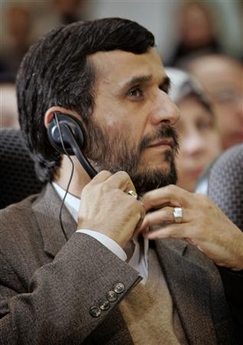 Iran's President Mahmoud Ahmadinejad listens to the translation of a speech during a meeting with foreign ambassadors in Tehran, February 13, 2006. [Reuters] |
Gholamreza Aghazadeh, director of Iran's atomic program, was quoted by ISNA students news agency as saying the centrifuge work relaunched at the Natanz pilot fuel enrichment plant was on a "small and laboratory scale."
"Injecting gas into one or a few centrifuges could not be termed enrichment," he was quoted as saying.
A diplomat close to the IAEA, the Vienna-based U.N. nuclear watchdog, said inspectors watched Iranians doing test infusions of UF6 into "less than 10 centrifuges" among a cascade of 164 operational at Natanz before it was mothballed in 2003.
Earlier in the day, Iran said no actual uranium enrichment work had begun but that preliminary work was under way to prepare centrifuges for production after the extended suspension in such work, maintained under Western pressure.
The West suspects Iran of trying to develop atom bombs under cover of a civilian atomic energy drive and persuaded the IAEA's governing board last week to report Iran to the U.N. Security Council for possible action, which could include sanctions.