European leaders expressed support for the referral, through a resolution
drafted by France, Britain and Germany on behalf of the European Union.
British Foreign Secretary Jack Straw said the vote showed "the international
community's determination to prevent the spread of nuclear weapons in the Middle
East."
EU foreign policy chief Javier Solana said through a spokesman that he hoped
the vote would send "a clear signal to Iran that it must comply with the demands
of the international community."
Russia's government urged Iran to "respond constructively" to the IAEA's
decision, "including the restoration of a voluntary moratorium on all uranium
enrichment works."
German Foreign Minister Frank-Walter Steinmeier said
the "convincing" vote sent a "clear signal to Tehran" to take account of
international concerns.
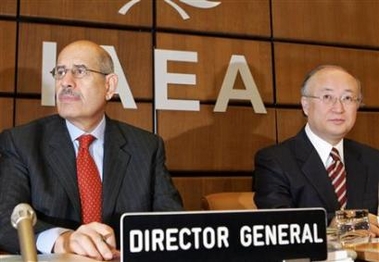
International Atomic Energy Agency (IAEA)
Director-General Mohamed ElBaradei (L) and the chairman of the board of
governors, Yukiya Amano, sit at the beginning of a board of governors
meeting in the U.N. nuclear watchdog's Vienna headquarters February 4,
2006. [Reuters] |
French Foreign Minister Philippe Douste-Blazy said he was "very concerned and
upset" by Iran's decision to retaliate.
The IAEA resolution links Tehran's referral to the country's breaches of the
Nuclear Nonproliferation Treaty and the lack of confidence it is not trying to
make weapons.
The text expresses "serious concerns about Iran's nuclear program" and
recalls "Iran's many failures and breaches of its obligations" to the arms
control treaty. It also expresses "the absence of confidence that Iran's nuclear
program is exclusively for peaceful purposes."
The resolution says IAEA Director General Mohamed ElBaradei should "report to
the Security Council" the steps Iran needs to take to dispel suspicions about
its nuclear ambitions.
These include that it return to freezing uranium enrichment; consider
stopping construction of a heavy-water reactor that could be the source of
plutonium; formally ratify the agreement allowing the IAEA greater inspecting
authority; and give the nuclear watchdog more power in its investigation of
Iran's nuclear program.
The draft also asks that ElBaradei share with the Security Council his report
to the March 6 IAEA board session and any subsequent resolution.
Chief British IAEA delegate Peter Jenkins urged Iran to heed the resolution
before March, warning: "Should Iran fail to comply ... it will fall to the
Security Council to bring additional pressure to bear."
His American counterpart, Gregory L. Schulte, indirectly acknowledged that
the Security Council's hands were tied until March, saying: "We're not talking
about sanctions at this stage."
But Straw said that if Iran failed to use the March window of opportunity,
Security Council action would be "almost inevitable."