Iran remained defiant, threatening to do precisely what referral was meant to
prevent. President Mahmoud Ahmadinejad ordered the resumption of uranium
enrichment and an end to snap IAEA inspections of its nuclear facilities,
according to state television.
"As of Sunday, the voluntary implementation of the additional protocol and
other cooperation beyond the Nuclear Nonproliferation Treaty has to be suspended
under the law," Ahmadinejad said in a letter to Vice President Gholamreza
Aghazadeh, who also is the head of the nation's nuclear agency.
Javed Vaeidi, deputy head of Iran's powerful National Security Council, also
said his country "now has to implement fuller scale of enrichment."
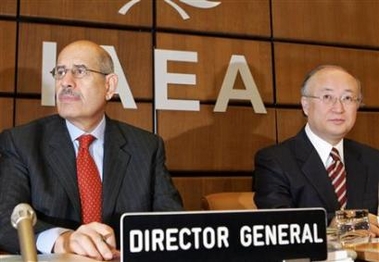
International Atomic Energy Agency (IAEA)
Director-General Mohamed ElBaradei (L) and the chairman of the board of
governors, Yukiya Amano, sit at the beginning of a board of governors
meeting in the U.N. nuclear watchdog's Vienna headquarters February 4,
2006. [Reuters] |
Iran says it wants to enrich
only to make nuclear fuel for generating electricity, but concerns that it might
misuse the technology accelerated the chain of events that led to Saturday's
referral to the Security Council. Tehran took IAEA seals off enrichment
equipment Jan. 10 and said it would resume small-scale activities.
Vaeidi also said a proposal to enrich Iranian uranium in Russia was dead.
Moscow has suggested that Iran shift its plan for large-scale enrichment of
uranium to Russian territory to alleviate international concern Iran might use
the process to develop an atomic bomb.
Other Iranian comment reflected Tehran's fury at Washington. The Islamic
Republic News Agency quoted Defense Minister Mostafa Mohammad Najjar describing
U.S. leaders as "terrorists and the main axis of evil in the world."
Najjar was responding to Defense Secretary Donald Rumsfeld, who at a
high-level security conference in Munich, Germany, repeated Washington's view of
Iran as the "world's leading state sponsor of terrorism."
Sen. John McCain, speaking at the same conference, said military action could
not be ruled out if diplomatic efforts fail to stop Iran from developing a
nuclear bomb.
European leaders expressed support for the referral, through a resolution
drafted by France, Britain and Germany on behalf of the European Union.
British Foreign Secretary Jack Straw said the vote showed "the international
community's determination to prevent the spread of nuclear weapons in the Middle
East."