Iranian President Mahmoud Ahmadinejad began a visit to Syria Thursday to
consolidate an old alliance made increasingly crucial as both countries face
mounting U.S. pressure and the threat of international sanctions.
Ahmadinejad and Syrian President Bashar Assad were expected to talk about
Iran's standoff with the West over its nuclear program and the threat to refer
it to the U.N. Security Council, as well as Syria's own troubles over a U.N.
investigation that implicated it in the assassination of Lebanon's former prime
minister.
Bilateral economic, industrial and cultural agreements also were expected to
be discussed during the two-day visit.
Syria is Iran's closest Arab ally. The two countries have had close relations
since 1980 when Syria sided with Iran against Iraq at the start of the Iran-Iraq
war.
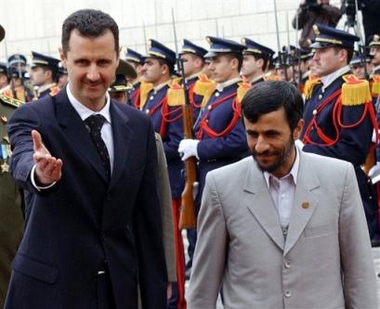
Iranian President Mahmoud Ahmadinejad, right,
and Syrian President Bashar Assad review an honour guard at the Ash Shaeb
presidential palace in Damascus Thursday Jan. 19,
2006.[AP] |
On the eve of the visit, Ahmadinejad
described bilateral relations as "strong and good."
Both countries share to a certain extent similar foreign policy objectives:
opposition to what they describe as U.S. attempts to dominate the Middle East,
hostility toward Israel and support for Palestinian and Lebanese militant groups
fighting the Jewish state.
Ahmadinejad's visit comes at a very delicate time for both nations.
Iran's insistence to proceed with its peaceful nuclear activities have raised
great concern in the European Union and the United States, which have been
pushing for referring the issue to the Security Council, a first step toward
possible sanctions.
Syria faces international accusations of failing to fully cooperate with the
U.N. investigation into last year's assassination of former Lebanese Prime
Minister Rafik Hariri. Investigators have implicated Syrian officials and now
want to interview Assad and his foreign minister. Damascus has denied any role
in the killing.
Syria sits on the 35-nation International Atomic Energy Agency board, which
meets on Feb. 2 for a vote on whether to refer Tehran to the Security Council.
Ahmadinejad on Wednesday accused the West of acting like the "lord of the
world" in denying his country peaceful use of nuclear energy. But the United
States and other countries are suspicious that Iran is planning on develop
nuclear arms.