Iran bristled at a warning from the U.N. nuclear watchdog to suspend
activities that could lead to an atomic weapon, but the agency's restrained
response made clear that the West wants to give diplomacy more time to ease the
standoff, the Associated Press reported.
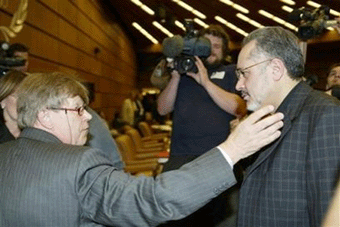
Deputy Director General of the International
Atomic Energy Agency (IAEA) and Chief U.N. Weapons Inspector Olli
Heinonen, left, gestures while talking to Iran's head of delegation at the
IAEA Sirus Nasseri prior an emergency meeting on Iran of the IAEA's
35-nation board govenors on Thursday, Aug. 11, 2005 in Vienna's
Internation Center. [AP] |
The International Atomic Energy Agency's 35-nation board of governors
expressed "serious concern" Thursday over Tehran's decision to resume uranium
conversion, stopping well short of reporting the regime to the U.N. Security
Council.
In a resolution adopted after three days of intense negotiations, the board
urged Iran to put its latest nuclear activities on hold to reassure the United
States and others that it is not concealing a weapons program.
But the implicit message to the Iranians was clear: Give negotiations a
chance to defuse the crisis.
IAEA chief Mohamed ElBaradei said he was "optimistic that we will continue on
the path of dialogue." Britain ¡ª which along with France and Germany has led a
European effort to entice Tehran with economic and political incentives instead
of threats ¡ª said it still hoped "there is a non-confrontational way forward if
Iran wants to take it."
Iran, which insists its nuclear program is peaceful and geared only toward
generating electricity, responded with indignation.
Sirus Nasseri, the country's chief delegate to the Vienna-based IAEA,
defiantly declared that his country would be a "nuclear fuel producer and
supplier within a decade" and dismissed the resolution as an attempt "to apply
pressure."
"This resolution is political," said Iranian Foreign Ministry spokesman Hamid
Reza Asefi, according to the state-run news agency. "It comes from American
pressure. ... It lacks any legal or logical basis and is unacceptable."
Diplomats speaking on condition of anonymity because they were not authorized
to discuss the proceedings publicly said Tehran faced a Sept. 3 deadline to stop
or face another possible referral to the Security Council, which has the power
to impose crippling sanctions.
In its resolution, the IAEA board gave ElBaradei a deadline of Sept. 3 to
give it a comprehensive report on Iran's compliance or lack of it.
Thursday's resolution did not mention the Security Council, given concerns
such a move could backfire by hardening Iran's position. Iran had said it would
rather endure sanctions than back down on a program it says is a matter of
national pride.
Security Council diplomats in New York say the IAEA may also be wary of
referring Iran to the council because there is a real risk the body would not
agree to sanctions. China, for example, has said flatly it opposes bringing the
issue before the council, and could use its veto power to block a resolution
punishing Iran.
President Bush, meeting at his Texas ranch with members of his foreign policy
team, welcomed the nuclear agency's warning to Tehran.
He also indicated that new President Mahmoud Ahmadinejad will receive a U.S.
visa to attend an annual United Nations gathering next month in New York; as
host, the United States is obligated under U.N. rules to approve visas to
foreign leaders irrespective of political considerations.
The IAEA board's next regularly scheduled meeting is set for Sept. 19, but
members can call emergency meetings at any time. This week's meetings had been
called by France, Germany and Britain after Iran announced it planned to resume
uranium conversion.
Iran had suspended that process and the subsequent enrichment process under
an agreement with the three European Union countries.
Tehran saw the text adopted Thursday as unacceptable because it would bar it
from enrichment and other related activities that it is allowed to pursue under
the Nuclear Nonproliferation Treaty, or NPT.
"All Iran wants to do is to enjoy the right under the NPT, the right which
has been denied to it for more than two decades," Nasseri said.
But he also told reporters that the Iranians did "not leave the door closed
to (the Europeans)" and would, for now, keep the enrichment process suspended
"to give a chance for negotiations."
EU envoys said in a statement that the burden was now on Iran to keep the
talks alive.
"A breakdown will be a matter of regret to the EU, because the EU hoped that
it could persuade Iran to take measures that might lead to a restoration of
international confidence in Iran's nuclear intentions," the statement said. "But
the EU is confident that another way of making possible the necessary
restoration of confidence in Iran's nuclear intentions can be found.