Russian muse
Updated: 2012-05-20 07:37
By Rebecca Lo(China Daily)
|
|||||||


|
Top: Bessmertny is arguably the former Portuguese enclave's most respected artist working today. Left: The show's large wooden lion sculpture eerily resembles the ones guarding the HSBC bank headquarters in Hong Kong. Black-and-white images, nonsensical words and absurd quotations litter the animal like postage stamps - intentionally clashing highbrow and street art with academic graffiti. Photos Provided to China Daily |
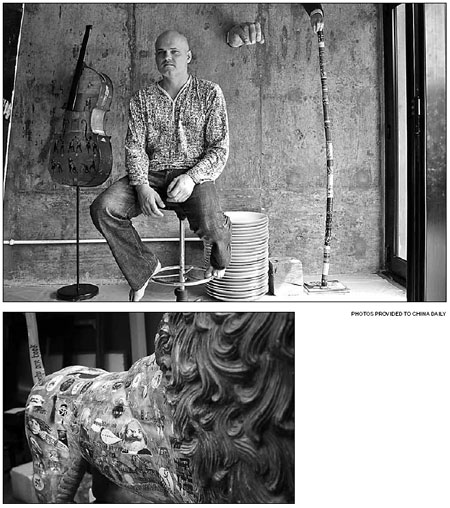
Macao-based artist Konstantin Bessmertny isn't afraid of controversy, and Rebecca Lo sees a lot to talk about in his one-man show Bestiarium at Amelia Johnson Contemporary in Hong Kong.
Russian artists - whether they are writers, musicians, ice skaters or choreographers - are known for their combination of technical skill and emotional oomph. Maybe it is the country's isolation. Maybe it is their history. Maybe it's those bitterly cold winters with plenty of time to think. No matter how far from home a Russian may reside, there is always an underlying melancholy in his work that is distinctively gut-wrenchingly beautiful.
Konstantin Bessmertny has lived away from his hometown of Blagovesthensk in the former USSR for decades. His first trip to Macao was to attend an exhibition of his work in 1993, and he found the combination of Portuguese and Chinese cultures fascinating. He made it his home shortly afterwards with his pianist and music teacher wife Gala, and raised two children there.
Bessmertny is arguably the former Portuguese enclave's most respected artist working today. Born in 1964, he studied at The School of Fine Art in Blagovesthensk, the Fine Arts Faculty at The Pedagogical Institute in Khabarovsk and The Institute of Fine Arts in Vladivostok. He has been a professional painter for three decades, with a distinctive style that on the surface appears formal, yet captures the bizarre with tongue in cheek humor and honesty.
From his studio set within the greenery of Coloane on the south side of the city, far away from its neon casino lights to be almost another galaxy, Bessmertny starts his day of work early. He is a disciplined painter, working Mondays to Fridays for eight to 10 hours, and more if he needs to prepare for a show.
He is currently taking a break after the flurry of activity for Bestiarium, his current one-man show in Hong Kong. His previous solo exhibition was over the winter at Beijing's AFA, an extension of the original gallery he helped set up in Macao six years ago.
"The title for my current series is taken from famous accounts during ancient and medieval times, describing creatures in a living world with man as a superior being within it," explains Bessmertny. "Only a fraction of the terrestrial and marine worlds were then known. And even now, I don't think we know even half of those worlds. The universe beyond our reach can only be imagined by using our unlimited imagination. Bestiarium attempts to reconstruct what we miss in our known world while imagining what is unknown."
Bessmertny draws much of his inspiration from Macao itself. "When I first came here, it was like traveling back to the 19th century," he remembers. "Macao was a sleepy, colonial town right out of a fairy tale. It was so dramatically different compared to Hong Kong.
"Then the transition happened. It began to decay. There was no development. People left Macao, thinking that they had no jobs - no future.
"Then, suddenly, it became a casino hub. Italians complain about tourists in Venice - they should see Macao! Tourists overwhelm the city. I really hope that Macao starts developing in another direction soon.
"This city has a knack for change and it adjusts well. I've witnessed it personally. In a way, I am still witnessing it. And ideas come. Parodies."
He feels strongly that the current direction of the Chinese art market's inflated prices is a path to self-destruction. "The works are all so formulaic and the artists are all about marketing themselves," he laments. "It's all in the same style. Smiley faces begat more smiley faces. A boom has been created for this sort of art in the market. But it lacks ethics. I have a mistrust of collectors. Look what happened with Vietnamese art: It died because everyone began collecting the same thing."
"Art fairs these days have so many bright and shiny things," he says. "That's not art: That's sensation. Art is something that touches you and makes you return."
Contact the writer at sundayed@chinadaily.com.cn.

(China Daily 05/20/2012 page5)