An anatomist who knows the leviathans inside out
Updated: 2012-02-19 08:37
By Carl Zimmer(The New York Times)
|
|||||||


|
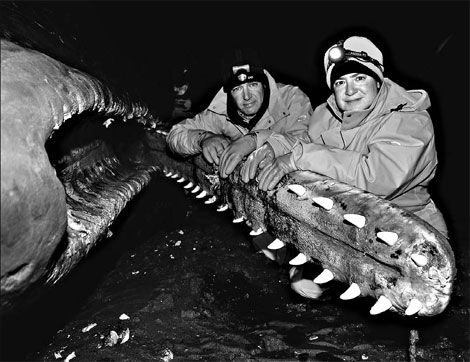
Joy Reidenberg, an anatomist, and Mark Evans, a veterinary scientist, were filmed while dissecting a sperm whale. Windfall Films |
Joy Reidenberg was in her laboratory at Mount Sinai School of Medicine in Manhattan when the phone rang.
A British television production company was on the line, wondering if she could fly to Ireland that night. They were about to start filming a series about the world's biggest animals and, by sheer coincidence, a 59-metric-ton fin whale had washed up on the south coast of Ireland. They wanted to film her dissecting it the next day.
Dr. Reidenberg has performed well over 400 dissections on stranded whales, but her role in the televised dissection turned her into a creature far more exotic than any of the animals she dissects: a celebrity anatomist.
She became a central figure in the series, "Inside Nature's Giants," which became a hit in Britain.
Dr. Reidenberg had to begin the dissection in Ireland by dealing with the bacterial gas that was building inside the whale's carcass. "It was inflating like the Hindenburg," she said. "If you cut in too deep, you end up with a million sausage links all over the place."
Her solution was to knife a series of holes in the whale's throat. "It's like defusing a bomb," she said. A rush of wind came from each one, producing a symphony of flatulence. It took an hour for all the gas to exit.
Next, she used a meat hook to haul herself about three meters up to the top of the 20-meter-long animal, where she carved long incisions into its side. A construction vehicle peeled away the blubber. Now Dr. Reidenberg could cut open a doorway into the whale's gut and haul out the intestines. The next morning, she climbed into the abdominal cavity. She located the vestigial pelvis, a reminder of whale ancestors that lived on land. She extracted the voice box, which was bigger than she was.
After two days of this, she went back to her hotel and tried to clean off the whale grease. Fifteen showers and three baths later, she flew back to New York with her skin still giving off a foul stench, like a refrigerator that has gone days without power. It took days for the grease to completely evaporate from her skin.
Dr. Reidenberg, 50, has been looking for anatomical clues to the evolution of speech, focusing much of her research on the most remarkable of all mammal voices: those of whales and dolphins.
She has found that the larynx of toothed whales extends all the way into the nasal passage, allowing them to open their mouths as they hunt, without getting water into the airway. "It's like having a built-in snorkel," she said.
She has discovered that the baleen whale's larynx is connected to a giant pouch. She has hypothesized that the whales sing by pumping air into the pouches, which then release vibrations into the surrounding water.
She hopes "Inside Nature's Giants" will bring attention to the science of anatomy. Anatomists' discoveries can have implications for humans: understanding how whales withstand huge pressures, for instance, may lead to new treatments for brain injuries from combat explosions.
Dr. Reidenberg says she loves hearing from the television show's fans about how much they love learning about the insides of animals.
"I love fan mail," she said. "I don't know what these celebrities are complaining about."
The New York Times
(China Daily 02/19/2012 page12)