An overlooked artist is gaining new praise
Updated: 2012-02-19 08:36
By Carol Vogel(The New York Times)
|
|||||||


|
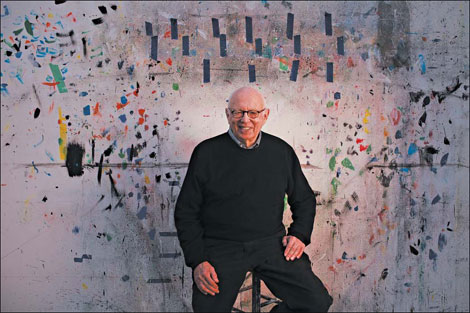
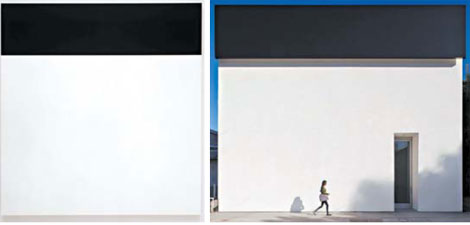
Matthew Marks's Los Angeles gallery has a facade echoing an Ellsworth Kelly painting. Fred R. Conrad / The New York Times; below left, Ellsworth Kelly / Matthew Marks Gallery; below right, Joshua White, Courtesy Matthew Marks Gallery |
SPENCERTOWN, New York - Ellsworth Kelly's seven-decade career has been an unwavering exploration of shape, line and color in their purest forms.
Refusing to be labeled a Minimalist or Abstract Expressionist, Mr. Kelly, who is 88, spent decades fighting for attention, while others of his generation - Andy Warhol, Roy Lichtenstein, Robert Rauschenberg and Jasper Johns - were grabbing the spotlight.
"Ellsworth never tried to second-guess art history," said Robert Storr, dean of Yale University's School of Art in Connecticut.
All is spare and modern in Mr. Kelly's studio here, with one exception: at the entrance is a mustard-yellow ladder-back chair with a multicolored woven straw seat inspired by van Gogh's paintings of his bedroom in Arles.
"I did this in shop class in sixth grade," Mr. Kelly said. "It was my first color spectrum." Pointing to the spaces between the slats, he said: "The negative is just as important as the positive."
Mr. Kelly's focus on abstraction may not have been a smart career move for years. But now abstraction is hot again, with canvases by Gerhard Richter fetching astronomical prices at auction and the recent Willem de Kooning retrospective at the Museum of Modern Art in New York drawing crowds.
"Time has always been very important in my work," Mr. Kelly said. "Tastes have changed recently, and although abstraction has been difficult, people are more open to it now."
In July two five-meter-high wall sculptures by Mr. Kelly were installed on the facade of the American Embassy in Beijing. He is juggling several new sculpture commissions and has a full schedule of museum exhibitions, including one of his wood sculptures at the Museum of Fine Arts, Boston, and a show of black-and-white works that opens on March 1 at the Museum Wiesbaden in Germany. Another exhibition of his prints and paintings is at the Los Angeles County Museum of Art, and in June the Metropolitan Museum of Art in New York will offer a show of his plant drawings.
Meanwhile, his art dealer, Matthew Marks, turned to Mr. Kelly for the opening of his first gallery in Los Angeles. Not only will it be filled with Mr. Kelly's works, but he has transformed the facade with a black sculpture in relief along the top, inspired by a collage and a painting Mr. Kelly did in the '50s and '60s.
"Ellsworth has been fearless in his commitment to the limitless possibilities of abstraction," said James Cuno, chief executive and president of the J. Paul Getty Trust in Los Angeles. "With concentrated imaginative power he has made some of the most beautiful and important paintings of the Modernist era. And he is at the height of his powers, not elegiac but ecstatic, filled with the wonder of seeing the world afresh."
Tearing around his studio here in gray flannel pants and sneakers, hampered only by long tubes for the oxygen machine that he is hooked up to because of a recent lung condition, Mr. Kelly pointed out a splattered area he called his painting wall. Unlike younger artists like Damien Hirst and Jeff Koons, who often direct studio assistants, Mr. Kelly creates everything with his own hand.
"I wouldn't feel right doing it any other way," he said. "Kids do anything these days, but I'm still an old-fashioned painter. Maybe in a few years when I'm too old, I'll need help, but what am I going to do, say to an assistant, put the yellow there?"
Mr. Kelly has been experimenting with painted reliefs since he lived in Paris, where, in 1949, he got to know John Cage, Merce Cunningham, Jean Arp and Constantin Brancusi, whose simplification of natural forms had a lasting effect on him.
"I began with cardboard painted reliefs," Mr. Kelly said. "Some of them were all white. And I've continued this relief work ever since. I like the relief of Romanesque architecture."
He draws constantly, sometimes making tiny sketches on a scrap of paper, even a folded cigarette carton picked up on a New York City street. "A shape for a painting could come from the shadow a leaf casts on a branch," said Mr. Marks. "He'll draw it over and over again and use it in a painting, a print, a sculpture."
An obsessive archivist, Mr. Kelly has kept examples of his work from every decade of his career, studying them continually for inspiration, as a way to move forward.
"He's making art as good as the art that inspired him when he was in Paris," Mr. Storr said. Comparing him to Mr. Johns, perhaps the only other major artist of his generation who is still working today, Mr. Storr continued: "To a great extent Jasper is a literary artist. His work is coded with secret messages. Ellsworth is purely a visual artist. With Ellsworth there is no message, just an experience."
The New York Times
(China Daily 02/19/2012 page11)