With the loud whistles and collective cheers of World Cup action already
fading, and the reality of fixing Germany's troubled economy once again
commanding headlines, many Germans share Eberhart Pluntke's desire to bottle the
past month's excitement and store it for later use.
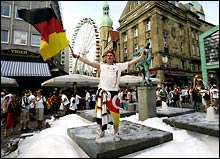
Many Germans, long
pegged as dour and pessimistic, let their brighter colors shine during the
World Cup. Here, a fan stands inside a fountain full of foam before the
July 4 Germany-Italy semifinal in Dortmund.
|
"The past four weeks have woken us out of
our sleep," says Mr. Pluntke, speaking over the clang of workers dismantling the
metal barriers outside Dortmund's Westfalen stadium, where Germany lost to Italy
in a narrowly contested semifinal last week. "I hope something will remain of
this time."
Germany's image abroad made immense gainsas foreign visitors braced for
uptight hosts and the specter of right-wing violence instead encountered a
country that took the World Cup's motto "a time to make friends" as seriously as
it took its soccer.
Among Germans, a new patriotism - unfettered by the weight of the past and
unfurled by countless flags adorning car and house windows - bloomed.
Fueling the excitement was the young German team, led by a dynamic coach
espousing American-style mantras of teamwork and positive thinking that
captivated a nation as they made an improbable run to the semifinals.
"This was the emancipation of a reunited Germany," says Alban Cajarville,
whose Berlin bar, Visite Ma Tente, became one of the city's most atmospheric
viewing spots as France advanced in the tournament. "The entire emotion from
this World Cup will help Germany in the future."
But the question confronting the country in the sobering days to come will be
how to harness that euphoria and use it to tackle the problems, from
unemployment to an unwieldy healthcare system, that have loomed over this
country in recent years.
Chancellor Angela Merkel, in an open letter congratulating German head coach
J¨¹rgen Klinsmann and the team in Monday's issue of the mass-daily Bild, signed
off with the hope that "the atmosphere that we Germans presented to the world
will last long past this summer."
German President Horst K?hler said Mr. Klinsmann and his team "gave the
country courage."
To some, it recalled an earlier time, when soccer was needed to lift the
country out of a more serious rut. Germany's surprising 3-2 victory in the 1954
World Cup over a team of superior Hungarians bore the country up out of the
ruins of World War II, giving it self-confidence and renewed standing in the
international community.The postvictory saying, "We are somebody again!" became
the country's rallying cry and helped Germany build itself back up in the
postwar years.
The situation is different this time around. Germany doesn't need to rise -
it needs to downsize. The social welfare system created during the economic
miracle is proving too costly for a reunited Germany and the demands of the
globalized economy.
International standardized tests reveal that the country's schools are
underperforming; the unskilled workforce is losing out to cheap labor abroad;
and Germany's standing as Europe's economic engine has been fundamentally
shaken.
But rather than inspire hope and tackle reform with the sort of vigor and
moxie Klinsmann exhibited in transforming a team of youngsters into World Cup
contenders, experts say Merkel's grand coalition has so far used the tournament
as a distraction to pass unpopular measures.
