Hamburg was founded under the name "Hammaburg " in 811, during the lifetime
of Charlemagne. The granting of customs and commerce privileges in 1189 marks
the beginning of Hamburg's ascent as a global centre of commerce.
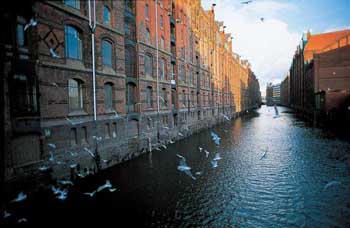
Speicherstadt:The free zone built at the end of the 19th
Century on the Brookinsel is known today as the Speicherstadt (warehouse
district). Coffee, rum, tobacco, electrical equipment and expensive
carpets are all stored
here.[FIFAworldcup.com]
|
As one of the
first members of the medieval Hanseatic League ("Hansa"), Hamburg was the
League's principal trading port on the North Sea. Kings and princes have never
reigned in Hamburg: Since the Middle Ages, it has been a city republic
self-governed by its own citizens.
Hamburg, which today is one of the 16 states of the Federal Republic of
Germany, has always strongly defended its autonomous statehood.
Hamburg's seaport is one of the world's seven largest container ports, and,
in terms of surface area, it is the largest seaport in Europe.
The port, and the 80,000 people who work there, are a distinguishing feature
of Hamburg. The city on the Elbe and Alster rivers is also one of Germany's
major media centres.
The German press agency dpa is located here, and 15 of the 20
highest-circulation German magazines are published in Hamburg. The city is also
internationally renowned as Germany's foremost centre for musical productions,
especially for musicals by Andrew Lloyd Webber such as "Cats" and "The Phantom
of the Opera".
Hamburg is the location of the International Maritime Law Court, and of more
consulates than any other city in the world, representing 100 countries.
Major sporting events are held in Hamburg throughout the year, and it is not
unusual for the entire city to be on its feet.
At the Hanse Marathon, for example. An elegant array of four-legged creatures
competes neck and neck at the show-jumping, at polo tournaments, and at horse
racing and trotting. In late summer, Hamburg's streets are given over to
cyclists racing in the HEW Cyclassics.
The international tennis world has its sights on "Rotherbaum" and the
Hamburger SV and FC St. Pauli football teams can be relied on for staging
hair-raisers every week. Hamburg's sporting activities have something for
everyone.
Each city district has several pitches and indoor facilities for the
"traditional" types of sports such as football, handball, tennis and
hockey.There are golf courses on the outskirts of the Hanseatic city and, of
course, Lake Alster and the River Elbe are excellent for water sports
enthusiasts. Yachting, rowing, kayaking, canoeing and even surfing clubs with
good training facilities can be found here.
