SPORTS> Germany 2006

|
SPORTS> Germany 2006
|
|
Host city: Berlin
(FIFAworldcup.com)
Updated: 2006-05-24 15:50
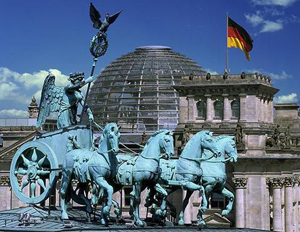
Berlin Since its foundation it has been Berlin's fate to be divided and re-unified. Within the confines of the Spree valley, between Koepenick and Spandau, Coelln was founded on the Spree Island and Berlin on the north bank. Coelln was first mentioned in a document in 1237. Coelln and Berlin were unified in 1307, the unification being annulled in 1442. This separation lasted until 1709. The city became the political centre of Brandenburg, Prussia and the German Reich. After the foundation of the German Reich in 1871, the city progressed quickly to become Germany's largest industrial and cultural centre. The Second World War (1939-1945) triggered by the National Socialists, the Nazis, had a devastating effect on Berlin and led to the destruction of large parts of the city. Subsequent political developments divided the country and its capital: The building of the Wall in 1961 drastically and brutally completed this separation. The Wall did not come down again until 1989, when the people from West and East Berlin were finally reunited. Berlin, the country's largest city, has once again become the capital of a united Germany, the Brandenburg Gate symbolising this re-unification.
Berlin is not only the seat of the government and cultural capital, but also Germany's sports city. More than 525,000 male and female athletes are registered in about 1,900 clubs; 160 teams from Berlin compete in the top leagues in most differing sports – including football, of course. From basketball to cycling, gymnastics, ice hockey, judo, swimming to volleyball and water polo. The Olympic Training Centre Berlin is the largest in Germany. It is not just by chance that Berlin, proportionate to its size and inhabitants, is very well represented in German Olympic squads. At the 1998 Olympic Winter Games in Nagano ten per cent of the German athletes came from Berlin. Berlin has a tradition as a sports city. Not only because the first public exercise site was inaugurated as early as 1811, but also because many sporting highlights are staged here year by year. For instance the Berlin Marathon, the international athletics event ISTAF, the women's international tennis championships, the CHI equestrian event and the Six Days in the newly built temple of cycling, the Velodrom. The city's currently most successful football clubs are Hertha BSC, which plays in the Bundesliga, and Tennis Borussia Berlin in the Zweite Bundesliga. |