News
Long history of vibrant global business
(China Daily)
Updated: 2010-09-02 07:52
 |
Large Medium Small |
|
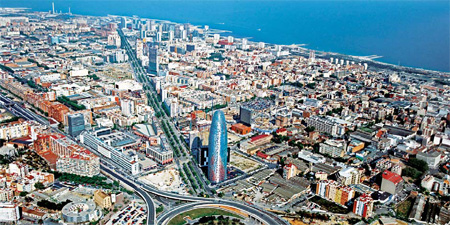
City administrators say Barcelona combines great living with an excellent business climate. |
Innovative Mediterranean city still flourishes through trade
Barcelona was first thrust onto the global stage in 1992 when it hosted the Olympic Games. The catalyst for a new era, the Olympics spurred economic growth within the industrial Mediterranean city. Situated on the northeastern tip of the Iberian peninsular, Barcelona is the capital of Catalonia, one of Spain's 17 autonomous communities.
Traditionally a textile region, Catalonia is now home to some of the most innovative service and manufacturing industries on the planet. Multinationals and local companies alike have found a business-friendly climate and excellent incentives there. Catalonia has more people employed in knowledge-intensive industries than London. And with more than 1.3 million workers, the region has an economy larger than Denmark's.
Barcelona is consistently ranked as a top European business city. It boasts a state-of-the-art international airport, a busy port, and a low-cost, efficient public transport system.
A high-speed train runs to Madrid several times a day, with new links to neighboring France and other Spanish cities opening soon.
In recognition of these assets, Barcelona was selected as an Urban Best Practice area at the Shanghai World Expo.
"Spain is our most trusted ally within Europe," said Premier Wen Jiabao.
Nearly 76 percent of Spain's investments with China originate in Catalonia, particularly in Barcelona. Currently, more than 500 Spanish companies have invested in China.
Business epicenter
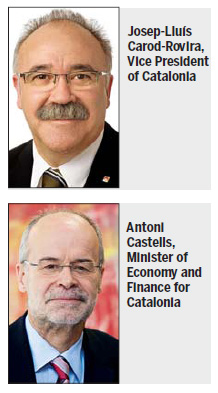
"Catalonia is the business epicenter of Spain. It represents 30 percent of the nation's exports, but only 16 percent of the population," said Josep-Llus Carod-Rovira, Vice President of the Catalan Generalitat.
"With between 30,000 and 40,000 companies, we have a strong sense of entrepreneurship. In fact, we have the most companies per capita in Southern Europe, which shows that Catalan society trusts in opportunity and possibility."
This intrinsic entrepreneurial spirit is encouraged through competition, Minister of Economy and Finance Antoni Castells explained.
"Catalonia has many small and medium sized companies that have internationalized with success. To help foster fair competition we offer technological help to businesses with limited budgets. We also facilitate financing options to support global expansions."
Minister Castells went on to express hopes that China and Catalonia could increase exchanges particularly with regards to direct investment, human resources and tourism. Barcelona is a knowledge hub of southern Europe, he said.
Forming strategic links
The city has already attracted hundreds of multinational corporations, and business owners are now seeking Chinese collaborations.
Catalonia would be an ideal base for Chinese companies wanting to move production closer to Europe, Carod-Rovira said, noting the region is home to a key Mediterranean port.
Josep Huguet, Catalan Minister of Innovation, Universities and Enterprises, similarly touted the area's advantages.
Catalonia has a wide range of facilities and services to support new businesses, he said. Companies have easy access to international transport networks, and can benefit from consolidated industrial clusters.
A new focus on research and development (R&D) has helped investment in the sector increase by 13.7 percent per annum.
"There are 3,500 multinational corporations in Catalonia, and almost 1,000 have production plants. Others, such as Microsoft and Hewlett Packard, have R&D lines," Huguet said.
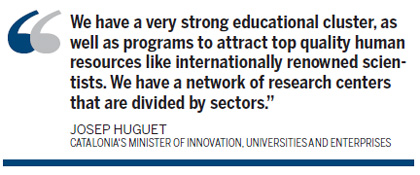
"The region has a very strong education system, and attracts top quality personnel," he continued.
"We have a network of internationally renowned research centers - the result of an R&D agreement between several universities, corporations, political parties and city councils."
Huguet also noted that Catalan businesses were world leaders in urban management, climate change initiatives and renewable energy. He hoped his region could set an example for other areas wishing to become more eco-friendly.
Top knowledge centers
Catalonia has four research institutions ranked among the top 100 in the world. It also houses six of Spain's top 10 universities.
While all welcome international students, the University of Barcelona is striving to attract those from China.
The UB currently has eight exchange programs with universities and institutions in China, allowing more than 300 Chinese nationals to pursue degrees in Spain.
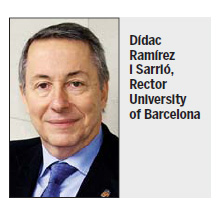
"With just under 65,000 students and more than 500 programs of study, the university is at the heart of Barcelona and the business community," said UB Rector Ddac Ramrez i Sarri.
"Since 1992, University of Barcelona researchers have cooperated with local private and public firms. Emphasis has been placed on health and the biosciences, but we are encouraging projects in the social sciences and humanities," Ramrez continued.
Such projects involve close collaboration with the city council, local authorities and the Catalan government. They focus on tourism and urban economic issues.
|
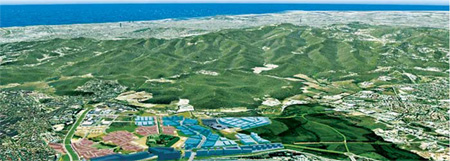
Parc de l'Alba: A competitive, world-class base for knowledge and technology firms seeking expansion in Europe. |
(China Daily 09/02/2010 page7)