REGIONAL> news

|
REGIONAL> news
|
|
Riding on both sides for success
By Qian Yanfeng and Huo Yan (China Daily)
Updated: 2008-12-11 07:42
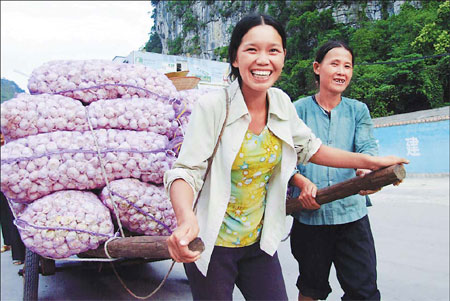
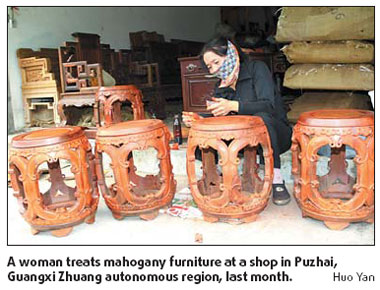
It is another day at the China-Vietnam border, with the hot and heavy air typical of the sub-tropics in November. Dressed in the traditional Vietnamese garb of indigo blue with a bright-colored headscarf and sandals, Bo Thi Hue unloads heaps of garlic from a truck under a sweltering sun. The Vietnamese, in her 30s, works as a full-time packer. The muggy weather belies the buzz that Hue is a part of, at the border town of Puzhai, north of Vietnam in Pingxiang in China's Guangxi Zhuang autonomous region. Carrying a transport permit, Hue walks half an hour every morning from her home in Lang Son province to this bustling side of the border and helps unload Vietnamese imports or pack Chinese goods for export into her own country. Behind her, trucks rumble past groups of buyers and sellers, all testimony to the prosperity of a town that claims one of the largest markets for China-Vietnam border trade. Stores and processing factories with bilingual signboards advertising Vietnamese fruits and mahogany furniture line the central avenue of this 2-sq-km township. Booming trade has also generated chains of restaurants, hospitals, hotels, banks and entertainment venues. With a permanent resident population of no more than 3,000, Puzhai nevertheless attracts thousands of businessmen and visitors every day seeking business deals. Last year, trade volume reached a record high of 3.5 billion yuan ($510 million), a 27 percent increase year-on-year. The city's trade volume with Vietnam now makes up one-tenth of China's total deals with the country, with Puzhai the biggest contributor, said Zhang Yang, deputy director of the municipal publicity department of Pingxiang. Yet, until the early 1990s, the town had been an outback containing less than 20 households of thatched houses dotted along mountain paths. Apart from the harsh natural conditions of this remote region, the locals also had to grapple with incessant border disputes and conflicts. In less than two decades, however, the villagers have become beneficiaries of a new border landscape, following the normalization of China-Vietnam ties in 1991. He Sheng, a senior researcher of China-Vietnamese relations from the China Institutes of Contemporary International Relations, said a shift in emphasis toward regional peace and stability has since promoted bilateral political and economic cooperation. "Both countries recognize they need peaceful relations across the border in order to develop the economy. With a follow-up policy to promote border trade, people from both sides have been able to share the benefits of modern economic and trade development, " He said. Over the years, trade volume between the two neighbors has also been growing much faster than expected. Last year's trade volume of $15 billion has already surpassed what was expected for 2010, He said.
In this remote basin area, Vietnamese like Hue now enjoy the convenience of traveling across the border in business transactions with Chinese neighbors. With an income of 50 yuan a day, Hue said she is making much more than what she would get back home tilling the fields. Her standard of living has "greatly improved" in the past decade, she said. "Things are much easier nowadays," Hue said in the barely intelligible Chinese she has picked up over the years. She is not the only one pursuing dreams of a better future in these parts. Luo Xiulian was among the first few locals to start selling Chinese goods across the border, bringing Vietnamese rice and aniseed to Pingxiang at the same time. As early as 1986, when there was still tension between the two countries, Luo, like many fellow villagers pressed by poverty, relied on border trade in return for food to feed her family of six. "Life was too hard at that time," said the 53-year-old mother of four grown-up children. "Income from the farmland could barely meet our needs as a big family. Somehow I had to find a way out," she said. It was not easy. Luo remembers hearing land mine explosions on her way to Vietnam. Once she was even caught and had all items she smuggled across the border confiscated. "I had to learn how to travel under the cover of night," she said.
Things did not start to look up until six years later, when Puzhai was officially established as a border town for locals to conduct trade with their Vietnamese neighbors. Encouraged by the new opportunities, Luo enlarged her trading business to include batteries and kettles as well as shoes and clothes, and settled down in the town with a small shop. "Chinese products are in great demand in Vietnam. At the height of the business boom, I sold 20,000 pairs of shoes in a single day," Luo said. A shy and modest woman at first impression, Luo could not conceal her excitement and pride when talking of these past experiences. Another decade later, Luo had bought herself two apartments in Pingxiang. She now enjoys a steady annual income of "hundreds of thousands of yuan". Other than lifting locals from poverty, the border trade has attracted people across the country with its promise of riches. Shrewd businesspeople from Zhejiang province and neighboring Guangdong province have also reportedly discovered the potential of trade in Puzhai. And there could be more to come. The government recently introduced policies to further promote border trade - starting November, the quota for duty-free imports at China's border towns has been raised from 3,000 to 8,000 yuan per day per capita. That means Chinese businesspeople now have a lot more leeway in their border transactions, observers said. |