Taking your place in the queue
By Zou Hanru (China Daily)Updated: 2007-07-13 07:11
 People in Hong Kong have a reputation for queuing up for things.
Thousands of people lined up in Central, Hong Kong, last Friday to collect environment-friendly shopping bags given away by a well-established designer. Some of them actually spent the night there in order to be first in the queue.
A similarly large crowd assembled the next day at the Hong Kong Stadium for tickets to a soccer tournament featuring English Premier League football clubs Liverpool, Fulham and Portsmouth.
And there were no reports of queue jumping.
There is joke about Hongkongers' readiness to create and join a queue. It goes like this: people of the city would get in line whenever they see a queue forming because they think there must be something good on offer. The longer the line, the more people are drawn in.
Very often, many of the queues are the result of corporate strategy to promote products and services. What better publicity can it produce than having people queuing up in front of TV cameras?
Other than souvenir distribution spots, stadium, and cinema ticket booths, one can also find people lining up at shops, restaurants, bus stops, and many other public places.
In the 1980s and 1990s, residential flats were the prime targets people queued up for. In recent years, with the property market not as vibrant and lucrative as before, it is IPOs, especially those for H shares, that generate crowds.
One may find it surprising that in spite of the hectic pace of life in Hong Kong, the local populace seem to show more patience when it comes to queuing than people in other parts of the mainland.
Compared with their mainland compatriots, people in Hong Kong are known for being well-mannered.
However, proper queuing is not something that is traditionally associated with Hongkongers. As a matter of fact, it took them decades to develop such a culture.
In the early years of colonial rule, the poor social manners of the local people were the targets of criticism, often from British nationals and well-educated migrants from the mainland.
My local friends recall that as late as the 1960s, bus companies had to launch educational campaigns to cultivate a proper queuing culture, something that did not register as a social norm until around the 1980s.
What is it that has brought about the changes? 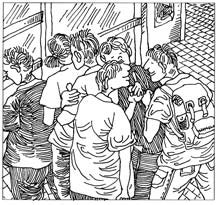
It is not by imposing fines although Hong Kong railway companies could by law penalize passengers who jump queues. Nor is improved public transport, which has certainly reduced, to a large extent, the necessity to push and shove for seats.
Rather, it was achieved by education of the general public - a proper queuing culture is to their benefit and a reasonable requirement for members of a civilized society. With the passage of time, the culture has taken root, and queuing up has become a habit.
This culture is spreading to the rest of the country. Beijing has made the 11th day of each month "Queuing Day", a move seemingly more aimed at cultivating civic culture than the needs of the Olympic Games.
It may take decades as well for the queuing culture to fully bloom, but Beijing's effort is certainly a good start.
Queuing comes from a time when there were not many places to get things or when there was a short supply of goods and services. But given the size of the population, queuing will stay for a while even when goods and services of every kind are in over supply in today's China. People will have to learn to wait their turn.
E-mail: zouhr@chinadaily.com.hk
(China Daily 07/13/2007 page10)
|
|
|
||

|
|