Mainland drivers need to shape up
By Zou Hanru (China Daily)Updated: 2007-07-06 06:57
 In the speech he delivered at the University of Hong Kong in
1923, Dr Sun Yat-sen said that when he studied medicine in Hong Kong in the late
19th century, he saw how well the colony was managed, and he realized our
country needed to change.
In the speech he delivered at the University of Hong Kong in
1923, Dr Sun Yat-sen said that when he studied medicine in Hong Kong in the late
19th century, he saw how well the colony was managed, and he realized our
country needed to change.
And change it did, especially in the last two-and-a-half decades since the country started to open up to the world and modernize itself. As a matter of fact, some mainland cities have already surpassed the Special Administrative Region on certain fronts.
Yet, as far as traffic management is concerned, the gap remains.
Many mainlanders, including myself, are surprised by the relatively smooth traffic flow here when they first come to Hong Kong.
Their first impression is that cars on Hong Kong roads move fast without causing chaos or frequent accidents. Drivers know what they should do when approaching intersections. They know when they have the right of way.
Certainly, like other major Chinese cities, Hong Kong is plagued by heavy
vehicular traffic, reckless drivers and careless pedestrians. 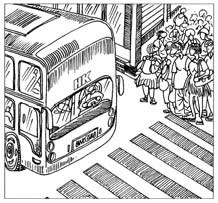
But traffic jams usually occur only during rush hours or when there are accidents or special events, like horse racing or soccer games, while in many mainland cities you can get bogged down in traffic at any hour of the day for apparently no reason.
One important reason for such frequent traffic snarls is the fact that there are too many vehicles on the road. Under the booming economy, cars have become increasingly popular in mainland cities.
South China's Guangzhou has 1.8 million registered vehicles on about 5,000 kilometers of roads, and the number is increasing by 16 percent a year. In Hong Kong there are 540,000 registered vehicles on some 2,000 kilometers of roads. That means there are many more cars per kilometer of road in Guangzhou.
The unchecked increase in motor vehicles is outstripping the growth of road systems on the mainland. To smooth traffic flow, this explosion in the number of vehicles must not be allowed to continue. Public transportation, which could reduce private car usage, must be made more accessible, convenient and comfortable.
More resources ought to be allocated to the enforcement of traffic laws and regulations. They are not lacking on the mainland but they have to be better enforced, say, through deploying more traffic police.
In addition, more attention should be paid to improving the road systems and town planning, which are crucial in effective traffic control.
Yet, while these measures are certainly necessary in bringing order to traffic on the mainland, they are not sufficient. There is one more thing without which none of these measures will be effective. It is a positive attitude of road users.
In Hong Kong, drivers are generally willing to abide by traffic laws. When there is a line drawn on the surface of the road forbidding vehicles to cross it, the line is respected. One or two drivers might breach the rule, but they do so with a sense of guilt. And they might be ticketed by traffic police.
Most pedestrians observe traffic lights. Jaywalking occurs, but not to such a degree as to affect traffic.
When everybody on the road does what they are supposed to do, traffic will be in good order. That is what is happening in Hong Kong.
What is happening in mainland cities is a general neglect of traffic lights, signs and regulations. Everybody is getting in each other's way.
Law enforcement alone is not enough. No law can be efficiently enforced without cooperation from the public. Municipal governments must launch traffic safety campaigns to educate the public and introduce special programs to correct repeated traffic law violators.
E-mail: zouhr@chinadaily.com.cn
(China Daily 07/06/2007 page10)
|
|
|
||

|
|