A site to remember
Updated: 2019-03-08 07:05
(HK Edition)
|
|||||||


The Nan Fung mills compound in Tsuen Wan has been reinvented as The Mills and its Centre for Heritage, Arts and Textiles is both a homage to and a center for the cultivation of the city's textile legacy. Liana Cafolla reports.
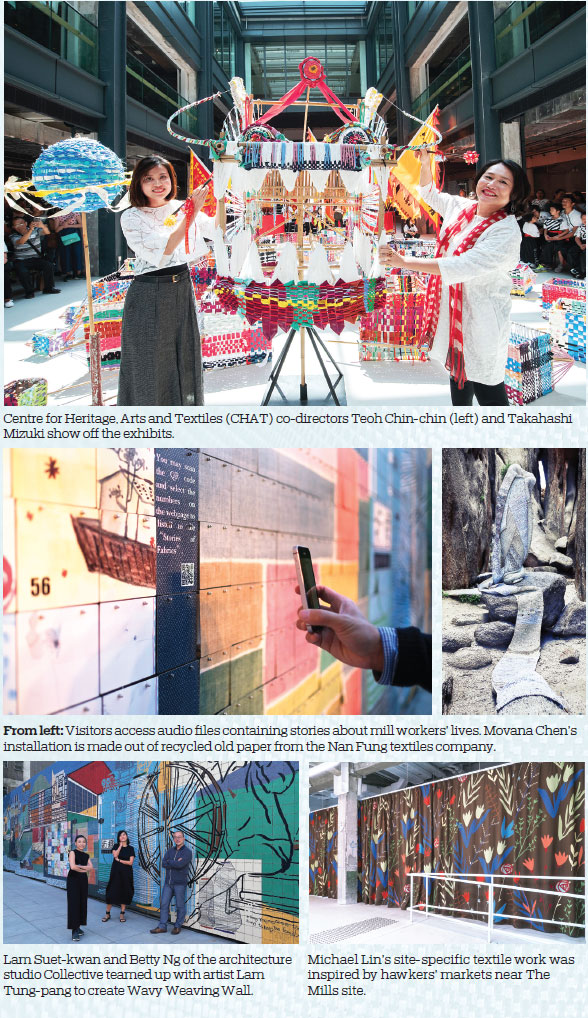
While Hong Kong's spinning mills stopped production decades ago, in the former premises of one of the city's most important cloth manufacturers, textiles in both new and familiar guises are very much alive. On what was formerly the factory roof of Nan Fung Textiles in Tsuen Wan is a pleasant green and concrete large open space. This is now the roof of the Centre for Heritage, Arts and Textiles (CHAT) section of The Mills, the new name of the old Nan Fung factory. Here, one long wall is now home to a large permanent interactive art installation called the Wavy Weaving Wall. Measuring 4 meters high and 23 meters in length, at first glance it looks like a mural - a colorful wall of visual stories related to textiles and textile-making that is singularly suited to its setting. But in fact it is a mobile art installation, composed of small squares that are designed to move in the breeze like a piece of fabric. It is also interactive - viewers can download QR codes on some of the squares to hear any one of the 56 short, personal stories and musings on the subject of fabrics. Many of the raconteurs are family members of former mill workers, or people from the area who are familiar with the factory and responded to a call on Facebook to share their memories.
The installation was created by the Hong Kong artist Lam Tung-pang and architectural studio Collective and took 18 months to complete. The idea of the piece was to "weave stories together, literally like a fabric," explains Betty Ng, founder and design director of Collective.
The stories collected were often very personal and touching, says Lam. For instance, one woman recorded a memory of her grandmother, who used to work in the textile industry and often brought home leftover pieces of fabric, which she would use to make toys for her granddaughter. Stories and reminiscences like this are what make up the fabric of a city, he says, adding that many of the personal and livelihood histories of people living near The Mills today are still linked to Nan Fung Mills, which was once a major employer in the area and is now a privately owned heritage conservation project.
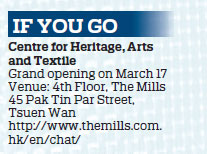
The wall piece is closely linked to the mission of the CHAT. Set to open officially on March 17 after months of pre-opening talks and exhibitions, CHAT aims to use its 17,000-square-foot space to reactivate Hong Kong's textile legacy.
"CHAT wants to change your mind about what's obsolete and what should be preserved," says Teoh Chin-chin. Both Teoh and Takahashi Mizuki, the co-directors of CHAT, see the facility as an art center with a unique historical and geographical heritage where visitors can also experience dialog and art in the making alongside artists, curators and members of the local community.
Showcasing a social fabric
Exhibitions here will change every three to four months with different themes and new artists in residence on three-month stays. Besides the Wavy Weaving Wall, another site-specific commissioned work was created by the renowned Taiwan artist Michael Lin, whose textile patterns are inspired by hawkers' markets in Tsuen Wan and traditional textiles patterns from Taiwan. His work has been placed in CHAT's lounge, a space for visitors to relax and mingle, epitomizing CHAT's aim of making textiles relevant and accessible in different forms.
Among the many talks, workshops and exhibitions planned for the coming few months is a curated exhibition by the architect collective Assemble and design firm HATO who worked with CHAT to put together the "Welcome to the Spinning Factory!" show. Highlighting Hong Kong's textile past, the exhibition will show more than 100 historical exhibits, including old machines, historical images, cotton products, documents and other memorabilia.
The variety of exhibit types included in the opening exhibition, "Unfolding: Fabric of our Life", featuring works by 17 artists and collectives from 12 countries and territories in the Asia-Pacific region, is testament to how textiles in various forms and their woven stories surround us in the everyday world. A commissioned piece by the Hong Kong artist Movana Chen is woven from old papers once belonging to the Nan Fung company. Alma Quinto made sculptures out of reused fabrics and books from upgraded textiles during her three-month residency at CHAT. She was assisted by nine Filipino domestic helpers working in Hong Kong who tell their own stories of migration through the exhibits. Works by the New Delhi-based photographic artist Dayanita Singh, known for her work in exposing labor and child exploitation, show various objects covered in red fabric, referencing hidden agendas in modern textile production, while a video installation by Aoyama Satoru from Tokyo alludes to how artificial intelligence will likely replace the human hand in creating painstaking embroidery.
A VR experience called "Re-spinning the Yarn", located in an old spinning room, is designed to recreate a feel of the shop floor when it was fully functional in the 1980s and earlier. Visitors can follow a short history of cotton production by donning a heavy headset which allows them to enter a 3-D world. Without moving from their seat, they can watch the cotton flower arriving in Hong Kong and then manipulate virtual machinery to see cotton being transformed into yarn and subsequently fabric.
Mizuki, who has worked in projects revitalizing the Roppongi district in Tokyo, says that while traditional spinning no longer exists in Hong Kong, the textile industry has evolved through startups to include other textile-related works such as upcycling, recycling and sustainable use of materials, ushering in a new era of textile work. "It's good not to go in only one direction," she says. "It's important to be the mediator and to create conversation. That's what we have to do at CHAT."
|
Wavy Weaving Wall spans a 23-meter space on CHAT’s roof, depicting scenes from the surrounding area and textile workers. It also hosts interactive oral histories. |

(HK Edition 03/08/2019 page10)