River to the past
Updated: 2017-12-08 06:25
(HK Edition)
|
|||||||


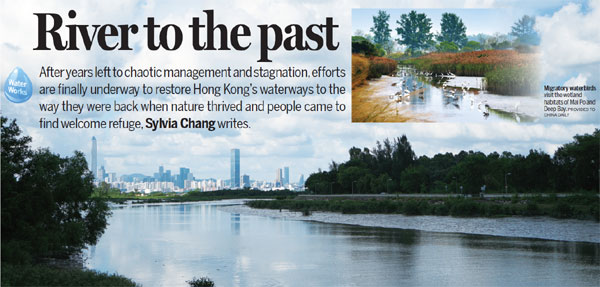
After years left to chaotic management and stagnation, efforts are finally underway to restore Hong Kong's waterways to the way they were back when nature thrived and people came to find welcome refuge, Sylvia Chang writes.
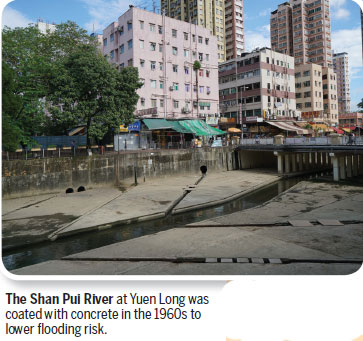
A long, thin nullah, its bed swathed in gray concrete, reaches through the Yuen Long New Town, steeped in the reek of algae and stale water. As seen from a drone aircraft, no pedestrians are in view, but the monotonous roar of the traffic on the road adjacent is endless.
Here was once a pastoral landscape, where farms dotted the land. The Shan Pui River attracted the Tanka people, the original settlers in this western part of the New Territories. They made their living by fishing and trading on poling boats and sampans on the river. Inhabitants of the tranquil village would be awakened to the sounds of the river traffic in the old days. Today, one of Hong Kong's great rivers of old has become a blight on the urban landscape.
The Shan Pui River is one of 200 rivers and streams in town, forming over 2,500 kilometers of waterways, that have been halted, channeled and forever changed - flora and fauna disappeared, and once verdant land reduced to brownfield amid the relentless encroachment of urban development.
A team from the Faculty of Social Sciences at the University of Hong Kong (HKU) has set out to restore some of the peace and tranquility of the once sylvan landscape. The team has undertaken a water initiative founded on the principles of sustainability and engagement between the waterways and surrounding communities.
With funding from the Hong Kong Jockey Club Charities Trust, the three-year project has set a goal to revitalize Hong Kong's rivers and raise public awareness of the importance of water sustainability for Hong Kong. The team expects to restore the old "water-friendly culture", rebuild destroyed habitats and still leave room for recreational activities on the water.
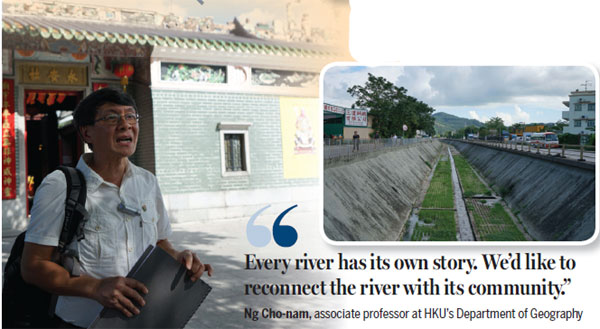
"Every river has its own story. We'd like to reconnect the river with its community," said Ng Cho-nam, a leader of the project and associate professor in the Department of Geography at HKU. He said each change in a community, even the slightest, affects the nearby river, whether it's widening a road, building a new property or revitalizing an old block. The vitality of a river links closely with the lives of the people and the place.
Course and community
The team created a database based on GIS (geographic information system) on Hong Kong's major rivers and associated river basins, exploring the history of the rivers, the stories revealed by the nearby rocks and minerals, the phases of the water cycles and their effects on the social and economic activities on surrounding communities.
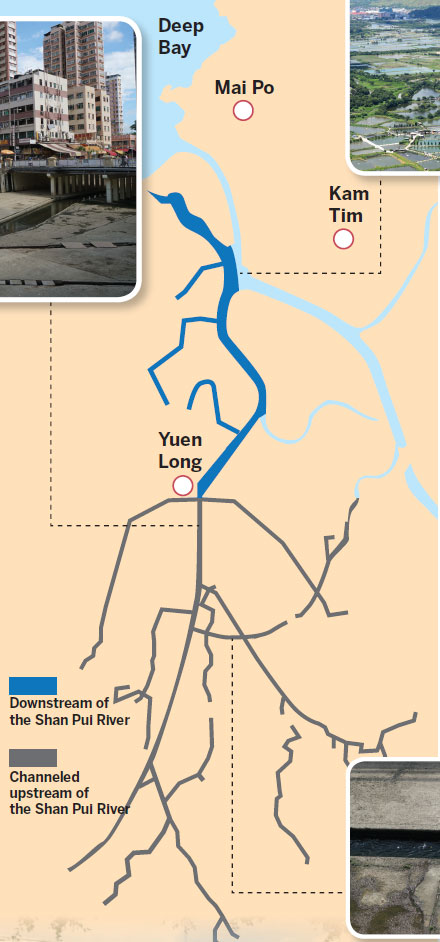
The river's origins are found in country parks, amid canyons and precipitous cliffs. The stream passed one village then another, sometimes paralleling roads and passing under bridges before flowing into wetlands. The river stretches over 29 kilometers. "It's the city of Hong Kong in miniature," said Ng.
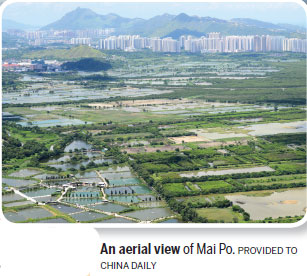
The tributaries of the Shan Pui River flow north from the source in Tai Lam Country Park in Yuen Long, 380 meters above sea level, making their way through small communities before joining the main watercourse on their journey into Deep Bay.
The tributaries of the river bring precious water to become the lifeblood of the villages along their course.
Going back to the Ming Dynasty (1368-1644), the Shan Pui River was a major navigation channel for trading throughout the region, Ng said. Residents from nearby came to the river and poled their boats to fish and exchanged meats and crops from the harvest.
Flourishing agriculture and fishing spurred the development of the first local market - Tai Kiu Tun Hui, and later Yuen Long Hui (literally, "Hui" means market) - located next to today's Tai Shu Ha Tin Hau Temple. Temples sprang up in the villages, dedicated to the worship of Tin Hau.
Tin Hau, also known as "Mazu", the Goddess of the Sea, is believed to have great influence over the sea and fishermen pay her their respects, praying that the coming year will bring a fine harvest.
In the 1960s, the Shan Pui River was channeled to reduce the risk of flooding. The riverbed was widened and straightened and its banks were covered with concrete. The reduced flood risk helped to spur development. Yuen Long became transformed from a quiet rural community into one of Hong Kong's bustling new towns.
One river, two systems
The Shan Pui River at Yuen Long is one of the many to have been channeled and overlaid with concrete. Most rivers in Hong Kong have been channeled. Ng of HKU identified the cause of this as "one river, two systems". It is a reference to the inconsistencies of management - two departments to manage one river.
In Hong Kong, the upstream waters are managed by the Water Supplies Department whose mission is to provide good quality water for the people of Hong Kong. Downstream, rivers are managed by the Drainage Services Department, which oversees flood prevention. Upstream waters are trapped and funneled into reservoirs to serve as a major source of water for the local community. What's left escapes to a nearly dry riverbed downstream. This, Ng said, "disrupts the natural water cycle of a river and obstructs the ecology system".
In Hong Kong, there is usually a sign near a river reading "Stay away from water course". It's considered a safety measure during flooding, Ng said. Most rivers, however, are not that dangerous, he added, especially out of flood season. Residents should not be too anxious about it and should come to enjoy the waterside, just as their ancestor did.
Ng said that apart from providing a source of drinking water, a river can have multiple functions, like providing drainage, ecological sustenance, aesthetic appeal, sites for culture and recreation and so on.
Also as a member of the Bird Watching Society, Ng said birds near lowland rivers are found in much greater abundance. Among the 166 species native to Hong Kong, 54 are freshwater dependent. He expects the ecology of Hong Kong's rivers to be restored, attracting birds to return and people to take pleasure roaming around the habitat.
Rebirth of a river
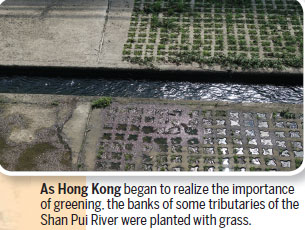
It took until the 1990s before Hong Kong began to realize the importance of greening. The banks of some tributaries of the Shan Pui River were planted with grass and mangroves as the slabs of concrete were removed. This, however, is far from enough, said Ng.
"Greening doesn't mean rebuilding an ecology. The river needs to recover its natural habitat," he said. The construction work that channelized the river ruined the surroundings and drove away living creatures.
Worse still, after an inflatable dam and the Yuen Long Bypass Floodway were built across the river, the natural linkage between Shan Pui River and Deep Bay was disturbed, preventing the movements of wildlife.
"What we need is a change in policy that water is not only for drinking. A river shouldn't be considered as a single-purpose resource," said Frederick Lee Yok-shiu, associate director in the Faculty of Social Sciences at HKU studying water governance.
Lee said a river should be managed as one ecosystem from the perspective of a river basin. "It's like air pollution. You can't manage it when there's a boundary."
Good news came in early August when the government announced its Yuen Long South Recommended Outline Development Plan. The plan includes the revitalization of the Yuen Long nullah. It will emulate the model of the well-preserved Cheonggyecheon stream in Seoul, South Korea, said Lau Wing-kam, chief engineer of the Civil Engineering and Development Department. Wetland plants will be planted on the concrete banks of the river, and facilities for pedestrians will be built to attract people to enjoy the space near the river, he said.
Contact the writer at
sylvia@chinadailyhk.com
(HK Edition 12/08/2017 page7)