Hong Kong must stop the demise of its tourist industry
Updated: 2016-03-31 08:41
By Eddy Li(HK Edition)
|
|||||||


While growth in the mainland economy is decelerating, as indicated by the government work report 2016 delivered by Premier Li Keqiang at the two sessions in Beijing recently, mainland residents generally remain enthusiastic about traveling abroad. According to statistics from the World Tourism Organization under the United Nations, the mainland's outbound travels grew by 12 percent to 120 million in 2015. The consumption power of mainland tourists is still encouraging for business people worldwide. Mainland travelers spent a total of $116.8 billion on luxury goods globally last year. This accounted for 46 percent of the international sales of luxury goods. As the world's largest source of tourists, the mainland still holds tremendous future potential for Hong Kong's tourism industry.
Yet the Hong Kong Tourism Board has revealed quite a different picture about the city's tourism industry. The organization's statistics show that Hong Kong received 45.8 million mainland visitors in 2015, down 3 percent year on year. This suggests many mainland tourists are bypassing Hong Kong in their outbound trips; they might have found that other places are now more attractive than the SAR.
Hong Kong, in the past, had always been the first choice for outbound travel by mainland visitors. But this situation has gradually changed over the past several years. During the Lunar New Year holidays in February - a traditional peak season for Hong Kong's tourism - the Immigration Department recorded 740,000 visitors from the mainland, posting a substantial drop of 11.6 percent compared with the same period during the previous year.
The city's retail industry has not fared any better. It has suffered a consecutive loss of sales for months. The 2015 gross sales value is HK$475.2 billion, 3.7 percent lower than 2014. The decline is even steeper than that in 2003 when Hong Kong was hit by the SARS epidemic. The sale of jewelry, watches and other luxury goods fell by a more significant 15.6 percent in 2015.
The dismal performance of the tourism and retail sectors in Hong Kong is partly attributed to external factors: Some foreign currencies have depreciated significantly, eroding Hong Kong's competitiveness as a tourist destination; some foreign countries have relaxed their visa requirements for mainland residents, and many countries have implemented tax reimbursement measures to attract mainland tourists. Yet the chief factor is an internal one.
In recent years, anti-mainland campaigns which were directed against mainland visitors have damaged Hong Kong's reputation as a hospitable city. The Mong Kok riot on Chinese New Year was a savage blow to Hong Kong's tourism. These anti-mainland campaigns have aroused strong antipathy among mainland residents. These have reduced the enthusiasm of mainland people for visiting Hong Kong. The Mong Kok riot has not only affected the number of mainland visitors, but also affected travelers from other countries or regions. These people may change their plans about visiting Hong Kong because they now feel the city has become a place where rioters can attack the police at will.
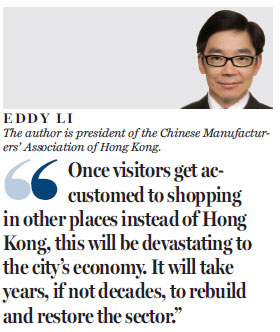
Hong Kong, for many people, was a shopping paradise where businesses of all kinds can converge. Without import duties and value-added taxes, Hong Kong is naturally a major market for all brands of luxury goods. We used to see many mainland visitors gathering on the Canton Road to purchase luxury bags and clothes. But this is much less visible now. The tourism sector is losing visitors, the retail industry is losing buyers, and Hong Kong is losing its economic vitality. Once visitors get accustomed to shopping in other places instead of Hong Kong, this will be devastating to the city's economy. It will take years, if not decades, to rebuild and restore the sector.
China National Tourism Administration has published the result of a recently conducted survey, listing the top 10 tourist destinations for mainland visitors during the Chinese New Year holidays, and in sequence, they are: Japan, Thailand, Taiwan, South Korea, Australia, Vietnam, Singapore, India, Hong Kong, and the Philippines. Not only have Hong Kong's ranking fallen dramatically, online searches of Hong Kong as a tourist attraction also appears to be declining.
We can no longer indulge trouble makers, who are purposefully destroying Hong Kong's social harmony. If we don't do something about this, then a deteriorating situation may not be able to be fixed.
(HK Edition 03/31/2016 page10)