A sauce of joy
Updated: 2015-06-22 08:30
By Zhou Mo(HK Edition)
|
|||||||


Chairman Charlie Lee of Lee Kum Kee tells of a corporate philosophy going back 127 years as the condiments legend continues to serve hundreds of Chinese flavors to the world. Zhou Mo reports.
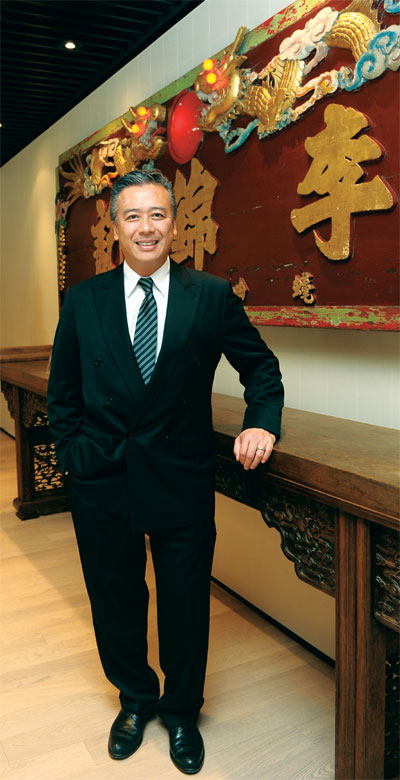
Charlie Lee Wai-chung, chairman of Lee Kum Kee Sauce Group, is a firm believer in the power of corporate philosophy on a company's development.
And so it is that the company motto "Si Li Ji Ren," or "Considering Others' Interests" is emblazoned everywhere, on the walls of Lee Kum Kee's office buildings, at its cargo pier, even on the sides of its shuttle buses - proof that the 127-year-old Hong Kong-based condiment enterprise is resolutely dedicated when it comes to living up to its core value.
Every year, Lee travels across the world to hold mass-communication meetings with staff in various locations, including the Chinese mainland, Malaysia and the US, to highlight the company's corporate culture and promote its core value.
"Business philosophy is very important in managing a big company well," said Lee. "You need to let your staff know what the company's core values are, what corporate culture the company believes in, so that they can work in the same direction with a common objective."
For Lee Kum Kee, the most essential manifestation of its core value is the adoption of its "100-1=0" quality management philosophy, as maintaining high quality is the top priority for the company producing well over 200 varieties of sauces and condiments.
"If one problem emerges, then all that you have done comes to nothing," Lee explained.
Lee is not unduly worried about competition, or that his products may be beaten by cheaper rivals on the market. That is because he believes consumers are more interested in buying high-quality and clean products, rather than being focused on the price.
But to survive in the competitive condiment industry, the importance of innovation can never be overstated, Lee noted. Amid lifestyle changes thanks to economic and social development, consumer needs are becoming ever more diversified, making it even more imperative for brands to polish their edge.
"Customer satisfaction is vital (to us). We strive to make products that cater to their demands," Lee said.
Lee Kum Kee now offers over 220 choices of sauces and condiments, marketed to more than 100 countries and regions worldwide, with at least 80 or more new choices being developed annually.
In the company's largest plant in Xinhui district of Jiangmen city, Guangdong province, more than 3,000 huge vats of soy sauce lined up in the 1.33 million square meter area, producing 600,000 tons of soy sauce every year.
Looking at the numbers, it seems hard to believe that Lee has just pulled his company out of a chilly winter.
Bouncing back
Between 2013 and 2014, Lee Kum Kee, 70 percent of whose business involves the high-end catering industry, suffered a severe hit to revenue after the central government in late 2012 launched a widespread crackdown on corruption and bureaucratic excess. The significant drop in the number of diners at high-end restaurants made a significant dent in the company's business, which even dropped by 30 percent at one point.
That posed a serious challenge for Lee, who was juggling the dual role of chairman and chief executive officer at the time. Given the massive volume of products on the line, the company faced dire times if it was not able to promptly find a substitutive market.
Faced with such a situation, Lee diverted the company's focus from high-end restaurants to chains.
He sought cooperation with big mainland chain restaurants such as Grandma's Home, Hai Di Lao Hot Pot and Bifengtang, and was eventually successful in halting the negative trend.
"A lot of efforts were made to pull the company out (of the crisis)," recalled Lee, who joined the sauce giant after graduating from the University of Southern California in 1985.
A member of the fourth generation of the family of Lee Kum Sheung, the company's founder and 1888 inventor of oyster sauce, Lee Wai-chung worked in various departments of the family-held firm before becoming chairman in 2012.
He has watched Lee Kum Kee grow from a small firm of less than 100 people to an international one with over 4,000 staff, and has so developed a deep understanding of how an enterprise can survive for decades or even centuries.
Quality first
"It takes years to build an outstanding brand. But it takes only one night to destroy it. The most important thing is to establish a solid quality basis," Lee said, while also pointing out the importance of talents.
In Lee's business philosophy, a company has responsibilities and missions that go far beyond mere trading of goods and he has focused diligently on bringing social benefits to the public. The company launched its "Hope as Chef" project in 2011 to sponsor mainland youths in underprivileged areas to learn Chinese cooking.
Over 70 students aged between 15 and 18 are selected each year to take part in the three-year program at vocational schools in Sichuan province and Beijing.
"The students come from very impoverished backgrounds, and would likely to be forced to end schooling if no financial support is provided to them," Lee said.
He smiled widely when told that the students are highly sought-after in the job market. The sauce group also donated toward the building of the Lee Man Tat Bridge and Infinitus Bridge in Jiangmen, both of which aim to improve the local traffic network and ease congestion.
"Corporate social responsibility is an integral part of the sustainable operation of an enterprise as well as a drive for constant entrepreneurship," Lee believes.
"We will continue to shoulder our corporate social responsibility and contribute to the sustainable development of the community."
Meanwhile, Lee is dedicated to fulfilling the company's mission of promoting Chinese cuisines worldwide.
It has signed a cooperative agreement with Confucius Institutes and has also held various culinary competitions in countries ranging from South Korea to Canada.
His vision is well-embodied in the Lee Kum Kee logo, a red bridge.
"It is a bridge between the East and the West, through which traditional Chinese cuisine can be spread and promoted," Lee said, pointing to the sign.
Contact the writer at sally@chinadailyhk.com
|
Charlie Lee Wai-chung, chairman of Lee Kum Kee Sauce Group, was instrumental in turning around the fortunes of Lee Kum Kee after profits took a hit amid a government austerity drive on the mainland. Provided to China Daily |
(HK Edition 06/22/2015 page7)