Hot Travel Line
Jinggang Mountain
(chinavista.com)
Updated: 2009-09-02 17:58
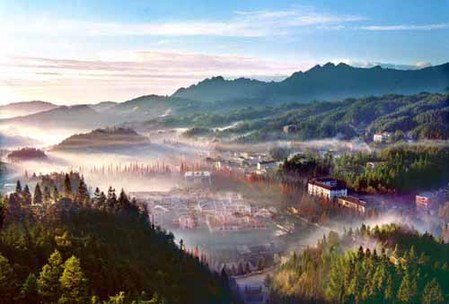
The lofty and majestic Jinggang Mountain, covering 670 square km, tower in the central part of Mount Luoxiao and stretch over the border of Hunan and Jiangxi provinces. It is ranged among "China Forty Best Tourist Attractions" and the cradle of the Chinese revolution. Guo Moruo marveled in his lines when touring the mountains, "After visiting Jinggang Mountain, no mountain will be an attraction."
The breathtaking mountains boast 100-odd peaks unique in shape, of the peaks, some look like tigers leaping over the deep stream, appearing in all their glory as if they were made by uncanny craftsmanship. The Nanping Peak, a sheer rise of thousands of feet, stretches for tens of miles, with hard rocks rocketing into the sky. The rocks in the shape of birds of beasts look so lifelike that they seem to change according to your imagination.
The Five Fingers Peak with an elevation of 1583 meters, is the highest peak and major symbol of Jinggang Mountain. It is so named because the peak, when standing together, resembles five fingers. The fame of the Five Fingers Peak grows with the print of its picture on 100-yuan RMB bill.
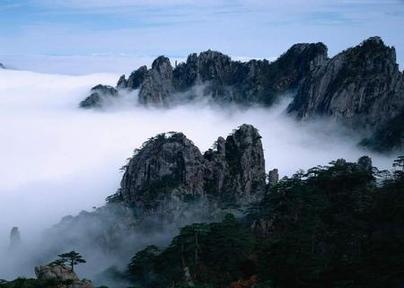
Dragon coming out of the cave. The waterfalls on Jinggang Mountain can rarely be found in other places across the world. Jinggang Mountain boasts a large area of mountains with rich vegetation. The streams enjoy a strong flow and a great drop; therefore, within the scenic zone there are over 100 waterfalls, grand and marvelous. The landscape of the eighteen giant waterfalls of five large pools, attracts thousands of visitors from home and abroad. Located in subtropical monsoon climate zone, Jinggang Mountain is abundant in precipitation. The mist evaporating from the forests is changing all the time. When floating halfway up to the mountain, it becomes strips of clouds; when drifting among the peaks, it turns into the valley for. If the shines over the clouds at the moment, a fantastic mirage will appear. The whole scene is as intoxicating as a fairyland.
Jinggang Mountain is a world of flora. In the one-million-odd-mu forest, pines, firs and bamboo, as well as medicinal herbs and Roaring into the sky. flowers and grass of various kinds are full of life and motion. Looking into the distance, one takes in sight a green sea of extending mountains and valleys. There are 3,800 plants of 400 families in the region.
Jinggang Mountain is also a world of fauna. There are a great variety of birds, beasts, snakes, insects and fishes living in the dense forest or in the streams. The region is rich in rare birds and animals. Among the 138 species of birds and beasts know here, over 20 are under national protection. The Hunan Tiger and tragopan are on the brink of extinction, and elaphodus caphalophus and river deer are rare animals unique to Jinggang Mountain.
During the Second Civil Revolutionary War, veteran proletarian revolutionists like Mao Zedong, Zhu De conducted operations here for two years pws four months leaving their traces among the mountains, waters and clumps of azalea. Which have now become the unique historic and cultural attractions of Jinggang Mountain Tourist Zone.
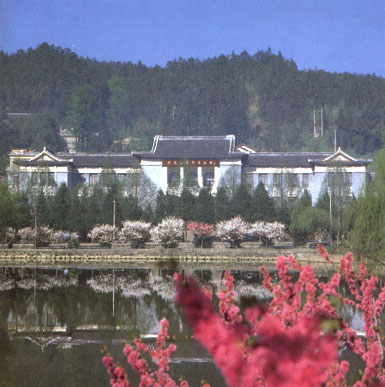
Jinggang Mountain Revolutiion Museum. The historic sites and the handsome landscape add radiance and beauty to each other, which fascinates visitors. Huangyangjie, standing on the border of Hunan and Jiangxi, is the site of the Battle of Huangyangjie Defense, and an ideal place for tourists to enjoy the sunrise and the sea of clouds. Preserved here are the former entrenchment, fortifications, barracks, and the Mongolian oak under which Zhu De and his soldiers often took a rest when carrying provisions.
The Monument to "Defending Huangyangjie Battle" makes the place more splendid and magnificent. Dajing, one of the five attractions of Jingganshan, s both fascinating with its pastoral scenes and famous for its once being the location of the residence of Mao Zedong, Zhu De, Chen Yi and Peng Dehuai. The deep limestone caves in Hexilong and the precipices in Zhushachong are Nature's masterpieces to the tourists today, and they were the perfect camping sites and century posts to guerillas of the Red Amy.
Site of the former Red Army Arsenal. Jingganshan Revolutionary Martyrs Museum at the foot of Xishan Mountain, the Memorial Hall to the Martyrs of Jingganshan Revolution halfway up Beishan Mountain the "Monument to Jinggang Mountain Revolutionary Martyrs" inscribed by Deng Xiaoping, the monument inscribed with the poem composed by Mao Zedong in 1965 when he revisited Jingangshan, Jingganshan Memorial Tower, and the Forest of Steles and the Sculpture Garden, all these sits unfold the strenuously glorious course of the Jingganshan Revolutionary Struggle and refresh one's memory of the past.