Su Jingping, a radio talk show host in Beijing, has two
objects - a small copper bell and a small piece of wood - that he now calls his
"most precious treasures."
Between February 16 and 24, Su paid a visit to the Nujiang River, one of the
last pristine rivers in this, the world's most populous country, with 19 other
environmentalists like himself.
His two "precious treasures" are items he acquired on the trip, which was
organized by several non-governmental environmental protection organizations.
The bell was once tied around a horse's neck, while he found the piece of
wood stuck in the pebbles in the bed of the Nujiang River and worn into an
interesting shape by the action of the water over the years.
Of course, much more than just these two small objects was brought back by Su
and his companions.
They took more than 1,000 photographs along the river, which flows from north
to south in the western part of Yunnan Province, in Southwest China, recording
with their cameras the extreme beauty of the area and the living conditions of
the local people, whose lives bear little sign of change over the past 100
years.
They have carefully selected 150 of their very best photographs to put on
display in the Jianguomen post office in Beijing, with the mini-exhibition
running until this coming Wednesday.
Their intent in holding such an exhibition is to share with the public the
wonders of their trip, as well as to boost the public's awareness of this virgin
area.
Sacred river
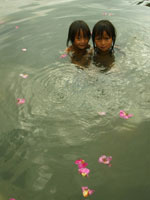
Two little
girls of the Lisu Minority bathe in a mountain pool in the Nujiang River
Vally. |
The Nujiang River has never been
a popular tourism destination.
Even those who see themselves as informed travellers, much better informed
than the general mass of tourists, would likely miss much that the area has to
offer.
Travelling in Yunnan they would more likely choose Dali - the capital of the
ancient Nanzhao Kingdom, the Jade Dragon Snow Mountain in Lijiang, or
Xishuangbanna as the best places to visit.
The Nujiang River is usually passed over "maybe because it is harder to get
to," said environmentalist Li Bo, one of Su's travelling companions.
From its headwaters on the southern slope of Tanggula Mountain on the
Qinghai-Tibet Plateau, the Nujiang River runs through one of China's most remote
areas, where it has carved canyons through the rugged mountain ranges east of
the Himalayas.
In a distance of 742 kilometres, it descends 1,578 metres, plunging through
gorges like a roller coaster.
It is one of the most challenging areas in the world for travellers.
"The scenery there is so utterly spectacular that all of us were
overwhelmed," said Li.
He is currently working for Conservation International, a United States-based
environmental protection organization, and also for a local centre for
biodiversity and indigenous knowledge. The avid environmentalist is a native of
Yunnan and has visited the area several times before.
He says that every time he sees the river's canyon a new feeling of awe
creeps over him.
The river runs through gorges unlike any others in the country, moving many
to call it "the Grand Canyon of the Orient."
The area boasts one of the world's most special canyon environments.
For the same reason that the area scares away ordinary travellers, it has
become a holy land for botanists, zoologists and explorers.
Having been traversed by so few, the valley area preserves well the original
ecological environment.
According to Wang Yongchen, one of the organizers of the event, the Nujiang
River flows through a region that is home to virgin forests, 7,000 species of
plants and 80 rare or endangered animal species.
"At least one quarter of China's indigenous plant species and half of its
native animal species can be found there," Li Bo said.
It is one of the most biodiverse regions in the world.
The Nujiang River is not alone. It is one of the family of rivers flowing out
of the Qinghai-Tibet Plateau to feed some of the most important waterways in
Asia - the Nujiang River, the Lancang River and the Jinsha River, which run
beside each other.
For this reason, the area, which has been designated a World Heritage Site by
the United Nations, is named the "Three Parallel Rivers" area.
The Nujiang River is one of the two rivers in the country that have never
been dammed, the other one being the Yarlung Zangbo, in the south of the Tibet
Autonomous Region.
According to development plans for the river, however, some dams are
scheduled to be built for power generation. Scientists and environmental
conservationists are debating the advisability of such plans.
Local people
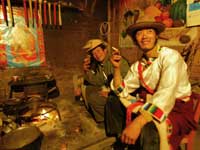
Members of a
local family in the Nujiang River Valley chat with visitors. The Family
has tibetan, Lisu, Nu and Dulong Ethnic minority blood in its
veins. |
What struck Su Jingping and his
companions the most was not the natural scenery, but the people living in the
region.
"There were villages on mountain ridges above the Nujiang River. The highest
villages seem to hang from the clouds," said Li Bo, adding that he was deeply
impressed with the Spartan life of the local people and the reassuring harmony
between human beings and nature.
"Many local farmers enjoy their quiet life very much. Sometimes we found
ourselves wondering why the local people built their homes in such high places,"
Li said.
He said this made him re-examine his thinking on a lot of things. He found
himself wondering whether the local farmers needed modernization to improve
their living standards, which would destroy their pristine and easygoing
life-style.
Li still remembers an experience in a village called "Peach Blossom Island"
in the township of Bingzhongluo. There he asked a local villager whether he
would like to own a car.
The villager said "no." For him, that "the livestock do not fall sick"
matters much more than owning a car.
Besides the biodiversity, the travellers were also impressed with the
cultural diversity.
The area is home to 22 minorities, including the Naxi, Lisu, Tibetan, Bai and
Yi ethnic groups.
These minority groups all have their own unique languages and folk customs.
In the township of Bingzhongluo, Li talked with a 27-year-old Tibetan man,
who is married and has two children. He lives with the family of his wife, a
situation regarded as humiliating in traditional Han Chinese culture.
"But in Bingzhongluo it is common for men to live with their parents-in-law,"
said Li Bo, who himself is of Bai ethnic origin.


