left corner left corner
China Daily Website

Europeans keen to share experience with Party

Updated: 2012-11-14 08:15
By Fu Jing ( China Daily)

 Europeans keen to share experience with Party

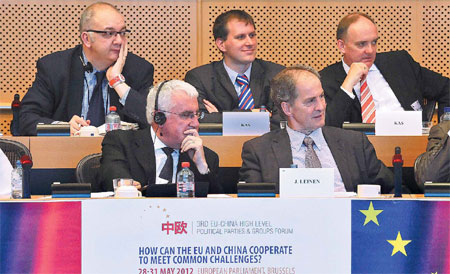
The Third EU-China High-Level Political Parties and Groups Forum was held in Brussels in May. Wang Jiarui (not pictured), director of the CPC Central Committee's International Department, made a keynote speech at the forum, calling for further consensus and cooperation to meet the challenges ahead. Wu Wei / Xinhua

 Europeans keen to share experience with Party

Pierre Defraigne, executive director of one of Europe's major think tanks. Provided to China Daily

Europeans keen to share experience with Party

Economic management, planning considered key areas of Chinese expertise, reports Fu Jing in Brussels.

Many Western political parties were once hesitant about deepening dialogue with the Communist Party of China but Pierre Defraigne is convinced that now is the right time to form closer ties and share the experience of managing China's fast-track economy.

Defraigne is executive director of Brussels think tank The Madariaga - College of Europe Foundation.

He has been impressed with the CPC's long-term planning and vision, qualities he feels are lacking in Western parties across the political spectrum.

Targets, such as the country's five-year plans, and sound management skills have resulted in the Party arguably outperforming Western policymakers in dealing with the global financial and debt crises, he said.

"The Western world is in a mess now, and its handling of the financial and debt crises has been a terrible economic and social waste," he said.

"The West's task (in economic management) is much easier (in terms of economic size and technological advances), but it has failed in the key dimension of the economy," Defraigne said.

Western parties should reassess their attitudes when looking at the CPC, which faces tremendous social and environmental challenges, and should take full advantage of the opportunities to learn through their exchanges with it, according to Defraigne.

A deeper understanding

However, this positive opinion is a relatively new development in European political circles.

When the CPC first proposed holding political debates with the European parties, many people were skeptical. Martin Schulz, who at that time was chairman of the European Socialist group in the parliament, was among those who questioned whether the increased contacts would be beneficial.

"The CPC wanted all the parties to be involved. But to what extent could a debate be useful?" Schulz, who became president of the European Parliament in January, recalled as thinking.

As the CPC holds its 18th National Congress and undertakes a crucial leadership transition, Schulz admitted that the CPC's proposal was a "very good idea" and said the debates have helped deepen his understanding of the Party's function and vision. "The exchanges are open-minded, pluralistic and very important," he said.

Although the CPC has maintained close relations with European parties for decades, the European Parliament's tough stance against granting China "market economy" status, on arms embargoes and human rights, prompted the Chinese government to set up regular forums to exchange ideas with parties and groups.

Since May 2010, the CPC and eight political groups in the European Parliament, such as the center-right European People's Party and the Progressive Alliance of Socialists and Democrats, have held four closed-door political debates on global challenges and areas of cooperation between China and the EU.

"I attended two of the debates. I was very surprised by the political debate when I participated in Beijing," said Schulz, speaking at the headquarters of the Social Democratic Party of Germany, commonly known as the SPD, in Berlin.

Schulz is still a crucial member of Germany's oldest extant party and is active in the politics of his home country. He often spends Mondays in Berlin at meetings with his party peers and the SPD maintains close ties with the CPC.

From the dialogues and encounters, Schulz, who entered politics after a career as an independent bookseller, has gained great insight into the role of the CPC and the capabilities of the Chinese leadership.

Under the CPC's leadership, China has achieved rapid economic growth during recent decades and during the past 10 years has become one of the most important and powerful countries in the world, he said. "China's economic clout has reached the highest level. As a European, I am deeply impressed with the country," he added.

Fourth bilateral pillar

For years, the CPC's ability to govern the country has benefited from frequent exchanges with political parties in developed and developing economies. High-level party exchanges between China and Europe could possibly become the fourth pillar in bilateral relations, after politics, economy and trade and person-to-person exchanges.

Joseph Daul, chairman of the Group of the European People's Party (Christian Democrats) is another European political figure to have sensed the CPC's greater openness. "The continuous dialogue with China over recent years has led to constructive commitments on both sides," said the Frenchman, who added that the frequent exchanges have helped both sides gain a deeper understanding of their mutual aspirations.

For the CPC, the increase in exchanges with political parties across the world serves two main purposes. First, to learn from the experiences and, especially, the failures of ruling parties in governing in a globalized world,; and second, to deepen its understanding of urgent global challenges.

Daul said there are many issues - climate change, the use of resources and international market regulation, among them - that can only be resolved through global cooperation.

He said it is crucial to have a regular and open exchange of views between European political parties and the Chinese leadership, based on mutual trust and close contacts, while maintaining their own systems. "Our development models are different. We believe in a pluralist system of different democratic parties with different philosophies and concepts to develop our societies."

In 2010, China and the Europeans established a high-level dialogue mechanism for party exchanges and Daul has attended most of the closed-door discussions on the financial crisis, climate change and party and state governance.

He said the exchanges are fruitful and he is looking forward to seeing how the new CPC leadership will continue to deepen dialogue and cooperation with the European counterparts.

"We hope that further progress can be made in different fields. We are optimistic that the new leadership will continue its reform policies and will reinforce our partnership," he said. "A strategic partnership and full respect for the idea of stability and predictability in our relations is what we envisage."

Misrepresentation

Despite these positive comments, Glyn Ford, a former member of the European Parliament and leading member of the Group of the Progressive Alliance of Socialists and Democrats said Europeans must continue to rebalance their mindsets when exchanging ideas with CPC members.

He said the International Department of the CPC makes strenuous efforts to engage European parties in political dialogue. "The European parties participate in these dialogues on a regular basis but the difficulty is that minds don't always follow bodies," he warned.

Ford also said that attitudes toward China continue to be hampered by misrepresentation and misconceptions that often have a political motive, and that sometimes the European attitude is perplexing: "While wanting Chinese help to resolve Europe's ongoing financial crisis, Brussels is threatening to start a trade war with Beijing," he said.

Both sides should continue with their exchanges: "Certainly, this is a forum that should not be neglected. With the ratification of the Lisbon Treaty, the European Parliament has become a central player in trade policy," said Ford, adding that the parliament's international trade committee has the potential to be come more powerful than the US Senate in issues such as trade. "Thus, although it is difficult political terrain, it is one which China must continue to engage," he added.

China has a cultural wealth that must be shared with the rest of the world and can even be integrated into the dialogues, according to Defraigne. "This is because we all have to think in terms of a more open, balanced global culture. The time of the cultural dominance of the West is over. Now it's about sharing those experiences and values," he said.

"We have to learn from the Chinese, as China might once have learned from the West," he said. For Defraigne, one key benefit of the Chinese approach is the ability to think about the long term, a factor that has given China a competitive edge in governance.

The country also has a tradition of transmitting its culture down through the ages and so successive generations share strong, continuous cultural links. "In this fast-changing world, the future of Chinese civilization is also important to Europe," he said.

He urged both sides to attach great importance to the rebalancing of economics and politics, something that's crucial for global stability and prosperity. "Capitalism has its advantages in terms of competition and therefore growth and jobs. But it's a dangerous system too, because it's unfair and unstable," said Defraigne.

He urged China not to commit the sort of mistakes seen in the West and argued that debate on the balance of politics and the market is absolutely essential to ensure that the different systems remain compatible. "China has a different development model from ours and America's. The compatibility of the different models is very important," said Defraigne.

Defraigne said China's efforts to grow have been fascinating, but were mainly about catching up, an extremely difficult challenge. "Now China needs to reinvent itself. This is very exciting, but much more difficult," he said.

The importance of ethics to the CPC was something he was keen to emphasize. The CPC must be perceived as seeking the common good for China's citizens and it is absolutely central that the CPC develops extremely stringent ethical standards for its members, from top to bottom.

"The image of a strong and healthy CPC would ease the formidable work it has to undertake," he said, adding that the country must become more effective in terms of innovation and environmental protection.

"It is a matter of survival for China. China can't destroy its environment. Innovation is about growth, and the environment is about maintaining the stock of resources," said Defraigne.

When the questions turned to topics such as equitable distribution of wealth, education, urbanization and bureaucracy, he was optimistic: "All these topics are crucial in party dialogues and we can learn from each other," he said.

Contact the author at fujing@chinadaily.com.cn

Liu Jia contributed to this story.

(China Daily 11/14/2012 page7)

...
...
...