Profiles
Chinese scientist finds wealth in solar
(AP)
Updated: 2007-04-23 06:50
 |
Large Medium Small |
SHANGHAI, China - Physicist Shi Zhengrong spent the 1990s in an Australian lab studying solar power, a field he picked by chance. He expected to devote his life to science.
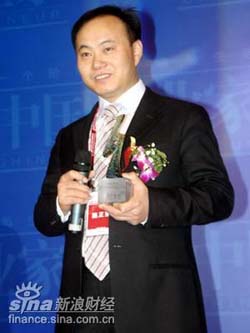 Shi Zhengrong [sina.com]  |
Four years later, Shi's confidence paid off when his Suntech Power Holdings Ltd. went public on the New York Stock Exchange and investors snapped up shares, turning him into a billionaire. Last year, Shi ranked No. 7 on the Forbes magazine list of China's richest tycoons, with a $1.4 billion fortune.
Today, he has traded his research smock for blue business suits, a CEO's 63rd-floor corner office and a role advising the Chinese government on renewable energy policy.
"We believed the share price would go up, but not so quickly," said Shi, a 43-year-old with a boyish face, chuckling at what he says was a rise marked by lucky breaks and timing. "I never thought I would be a rich guy."
Shi is the leader of an emerging group of Chinese entrepreneurs who are striking it rich by meeting fast-growing demand in China and abroad for cleaner power.
They are getting a boost from China's efforts to curb environmental damage after two decades of breakneck growth that have left it with some of the world's most badly polluted air and water. Chinese leaders also are promoting renewable energy in hopes of reducing mounting dependence on imported oil, which they see as a strategic weakness.
"The technological prowess of China is growing a lot faster than people in the West reckon," said Andrew Wilkinson, co-manager of a fund at investment bank CLSA Emerging Markets that invests in Asian clean-energy industries.
Suntech's 3,500-strong work force at four sites in China produces photovoltaic cells, the delicate, hand-size black silicon panels that can transform sunlight into electricity.
At a time when China's leaders are trying to turn lumbering state companies into nimble global competitors, Suntech already goes head-to-head with Japanese and European rivals in foreign markets. Shi says all its technology comes from its own labs.
By last year, Suntech had risen to be the world's fourth-largest solar cell maker, according to an annual ranking by Photon International, an industry magazine. Japan's Sharp Corp. is the market leader and other competitors include Q-Cells AG of Germany, Kyocera Corp. of Japan and BP Solar, owned by British oil company BP PLC.
Worldwide, experts expect the industry's sales to grow by 20 percent to 40 percent annually in coming years.
Suntech's key markets are Germany, Japan and Spain, which subsidize renewable energy by requiring utilities to buy solar-generated power and to pay more for it than they would for electricity from oil or gas.
China accounted for just 10 percent of Suntech's 2006 sales of $599 million. The equipment is expensive enough that its use in the company's home market is limited to lighthouses, remote military posts and other sites far from power plants.
But Shi says the Chinese, US and other markets will grow quickly as governments respond to concern about global warming by rolling out clean-energy initiatives. Beijing has ordered Chinese utilities to generate at least 10 percent of their power from solar, wind, hydroelectric and other renewable sources by 2010, with the target rising after that.
Despite his science background, Shi talks like a tough-minded businessman, and people in the industry say he is an able entrepreneur who moves between East and West and the worlds of technology and finance. He shifts easily between English and Chinese, and broke off twice during a 30-minute interview to take rapid-fire calls on his cell phone, first in the Shanghainese dialect, then in Mandarin.
"He comes across as a strong CEO who has a strong vision for his company and the future of his industry," said David Edwards, an industry analyst for ThinkEquity Partners in San Francisco.
Shi is part of a generation who left China by the tens of thousands in the drab 1980s to study or work. They're now trickling back, lured by its booming economy's new opportunities.
He is part of a growing group of returnees who are benefiting from government support for technology and new protections for private business. A few, like Shi, have become super wealthy by selling shares in their ventures on foreign stock exchanges.
Shi works 10- to 12-hour days and spends eight months a year on the road in Europe, the United States or China. But he said he wants to devote more time to charity work, including an environmental education program that he launched with his wife.
Shi said he has little time to enjoy his wealth.
"I'm a scientist," Shi said. "My hobby is solving technical problems."
Shi arrived in Australia in 1988 to spend a year at the University of New South Wales after getting his Ph.D. in physics in China.
China had little to offer, so when Shi's fellowship ended, he hunted for a new post in Australia. A friend sent him to see Martin Green, a New South Wales professor and solar pioneer. With no background in the field, Shi talked his way into a job.
"I really got into solar power by chance," he said.
Shi took a job at a company formed to commercialize advances made by New South Wales researchers. He and his Chinese-born wife bought a house in Sydney. He became an Australian citizen in 1993, with no plans to return to China.
"I never thought this solar business could take off or become commercially viable," he said. "I thought I just needed to concentrate on my research and publish papers to do my job as a scientist."
But in the mid-1990s, Shi started visiting China regularly to lecture on solar power. Friends lobbied him to return to China.
At the same time, Shi was getting restless in Australia and wanted a new challenge. He made a snap decision after a two-week visit to China left him "really excited" about its potential.
"My life was too easy over there," he said. "I thought if I came back I could do something really good."
The government of Wuxi, a city on Shanghai's western outskirts with ambitions as a high-tech center, put up $6 million to finance Suntech, which started with 20 employees, and helped to land $5 million in research grants.
"A lot of scholars aren't successful (in business) because they don't have a sense of marketing and sales," Shi said. "From the beginning, we had a very strong sense, whatever we do we have to make money as soon as possible, because there is no money for us to burn."
Suntech's main 120,000-square-foot factory is still in Wuxi, though Shi bought out his state backers before the IPO with the help of private investors led by Goldman Sachs.
At the Wuxi factory, technicians in green Suntech uniforms, surgical masks and hair nets turn 4-inch silicon discs into solar cells.
The cells are coated with power-producing films and sandwiched between sheets of glass in groups of 72 to form solar panels, each capable of generating 175 watts of power. That is too little to power three typical 60-watt light bulbs, but Suntech notes that it will light many more energy-saving bulbs.
Production is growing so fast that just two years after the factory opened in a special high-tech zone, Suntech is building a new one the same size a block away.
Shi said Suntech's goal is to develop superior technology, not just rely on China's low labor costs. But he said lower prices for skills and equipment will give the company an edge by making its $20 million annual research budget go further. A technical college graduate can be hired for 2,000 yuan ($250) a month.
Shi said that as technology improves, Suntech hopes to be able to cut prices within five years from the current $3.50 per solar panel to $2.50 - a level that he said would compete with traditional power in California, a big potential market.
Other Chinese companies are springing up to supply solar equipment, wind turbines and pollution-control technology. A Chinese law that took effect Jan. 1 - Shi helped to draft it - requires local authorities to favor renewable energy. The government has ordered power plants and factories to start complying with long-ignored emissions standards.
Those initiatives will create opportunities in industries ranging from wind turbines and nuclear power plants to pollution control and raising crops needed to produce ethanol and other clean-burning fuels, said Jing Ulrich, chairwoman of China equities for JP Morgan.
"It's so huge," Ulrich said, "no one can estimate the scale."