Twelve-year-old Luo Xiaofeng refused to have dinner with his parents on the
15th day of the first lunar month, the last day of the Chinese lunar new year.
Instead, he sat on the doorstep sobbing. "They are leaving for Xiamen
tomorrow, and I don't want to let them go," he cried.
It was the first Spring Festival in three years in which
his parents had managed to come back to Sandu, a small town in the eastern part
of Ningde, Fujian Province, to spend the holiday with him.
|
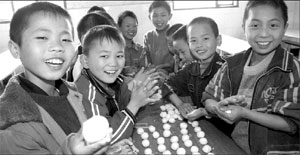
Children from Huaying Lanyi Migrant Workers' Children's School in
Guang'an, Sichuan Province, prepare glutinous rice flour dumplings on the
15th day of the first lunar month, on March 4, to celebrate the last day
of the New Year and the start of a new semester. The school has more than
400 such students whose parents have left their hometown to find a job.
Qiu Haiying |
"I know they have to go to make money for a living, but I just don't want
them to go," he said.
The boy finally joined his family, though his tears never stopped flowing.
The joy of spending 20 days with his parents was far from enough, and made it
difficult to say goodbye.
Luo stays with his uncle's family while his parents are away.
"I miss them a lot, especially when I see my friends with their parents," he
said.
Luo is not alone. Government statistics show that more than 20 million
children in rural areas whose parents have left home to search for work in the
city.
The problem has reached a national scale as more and more migrant workers
from across China answer the call of employers in the country's booming cities.
The splitting up of families poses a challenge to traditional household
structures and approaches to child-rearing, said Xie Guangxiang, deputy
secretary-general of Anhui Provincial Government.
In a proposal to the ongoing National Committee of the CPPCC, Xie urged the
whole country to think seriously about the situation.
"The issue is becoming a source of social problems, and we have to
appropriately address it," he said.
Among the potential problems stay-at-home children face are the absence of
any sort of family education, degraded school education and other psychological
problems.
A survey of people in Jingmen, Hubei Province, showed that stay-at-home local
children suffer from poor living conditions, lagging educational attainment,
insecurity and difficultly in communication.
Located in the heart of Hubei Province, Jingmen has a population of three
million people, 73,000 of whom are children who are separated from their
parents.
The survey, conducted by the All-China Women's Federation (ACWF) in May last
year, involved 181 children, 95 boys and 86 girls. The results were published
last week on the federation's website.
Some 87.9 percent of the children surveyed said they were willing to stay
with their parents. About 90 percent said they felt insecure when they left
alone.
The five most pressing concerns for such children are tutoring, psychological
help, security, financial support and communications.
"We should try to help them solve these questions," said Zhang Ling, a CPPCC
member.
"If we do not answer these questions, they will develop into social problems
like juvenile delinquency and isolation from the society."
To deal with the issue, a dozen government-related bodies, including the
Office of the Rural Workers United Conference under the State Council and ACWF,
set up a working panel in October last year.
The panel is to cooperate with other government bodies, including the
Education, Public Security and Finance ministries, to gradually put in place
laws and regulations to safeguard the rights of stay-at-home children.
"We should do more research on the issues affecting these children to come up
with new solutions," said Gu Xiulian, chairperson of ACWF, during a
video-conference in November last year.
She also called for the establishment of more kindergartens and libraries in
rural areas to help stay-at-home children, noting that 1,000 demonstration
schools had been established across the country.
"But that's far from enough," Xie said. Children left behind in the
countryside by migrant workers need more social assistance, he said.
Xie recommended several measures, including a special policy to guarantee
educational opportunities for stay-at-home children, accelerating the
establishment of pension and medical care systems in rural areas and encouraging
enterprises and non-governmental organizations to help such families.
"We need to further improve the compulsory education system in rural areas
and build up a system to guarantee the psychological health of children, as well
as the custody system," he said.
"We should also try to narrow the economic and social divide between the
regions."
(China Daily 03/14/2007 page7)